
D-1.1 Describe Piping and Tubing Materials
It’s important to be able to identify the piping and tubing you’ll be working with. The key to this is recognizing the material from which it is made. Modern pipe is generally made from metal, metal alloys, and varieties of plastic. Other specialty piping materials include rubber, synthetic rubbers, glass silicates, and composite materials. In the past, pipe materials included asbestos cement, glazed clay, wood stave, or lead. You may encounter these pipes in older structures and underground, and it’s important to be able to identify them. You’ll also have to know how to repair, remove, or adapt new piping materials to older pipe.
Your customers will view you as an expert in your field. You can expect to be asked about the piping system you are using, and you will often have to make recommendations for your client.
Pipe versus Tube Terminology
In common usage, the words pipe and tube are the same thing. However, in industry and engineering, the terms are uniquely defined—a tube is a pipe with walls that are too thin to be threaded. Tube is typically defined by outside diameter and tighter tolerances, while pipe is defined by nominal inside diameter. Throughout this section, the words pipe and tube may be used interchangeably.
Definitions
It is helpful to know the following terminology when you talk about pipes and tubes:
hose: Portable and flexible pipe made from flexible material such as natural rubber, synthetic rubbers, plastics, and composites with metal reinforcing.
interference fit: The contact made as a plastic pipe is solvent-cemented into the fitting socket. When ABS or PVC plastic pipe and fittings are dry-fitted, the pipe will not easily slide to the bottom of the fitting socket. This is because the fitting socket is tapered slightly to a smaller inside diameter at the base of the socket. The taper causes enough pressure on the solvent-cemented surfaces to cause the ABS surfaces to fuse together. It’s a misconception that ABS solvent cement is glue—it’s actually a solvent that softens the surfaces it is in contact with. The interference fit forces the surfaces to fuse together.
IPS (iron pipe size): Used to identify standard dimensions of a carbon steel pipe, which is often referred to as “iron pipe.”
NPS: Nominal pipe size. This is the approximate inside diameter.
NPT: National pipe thread. May be referred to as MPT (male pipe thread) for external threads, and FPT (female pipe thread) for internal threads. (Note that FPT and MPT are not authorized designations according to the ANSI standard.)
potable water: Water safe for human consumption.
pipe: Pipe is generally specified by a nominal inside diameter with a constant outside diameter (OD) and a schedule rating that defines its thickness. Pipe is generally manufactured to one of several international and national industrial standards. In general, “pipe” is the more common term in most of the world, whereas “tube” is more widely used in the United States.
print-line: The line of markings printed on a pipe that identifies its size, type, approvals, etc.
SDR (standard dimension ratio): A number that compares a pipe’s outside diameter to its wall thickness to show how strong it is and how much pressure it can handle.
SDR number: SDR number is determined by dividing the outside diameter of the tube or pipe by its minimum wall thickness. A lower SDR number means thicker pipe walls and higher pressure rating.
standard: A body of rules or principles established and agreed upon as valid and fundamental in a certain field or industry.
thermoplastic: A plastic capable of softening or fusing when heated and which hardens once cooled. Can be reheated and melted. Polyethylene and polyvinyl chloride (PVC) are examples of a thermoplastic.
thermoset: A plastic capable of becoming permanently rigid when heated or cured. It cannot be reheated and re-melted. Fibreglass pipe is an example of a thermo-set plastic pipe.
tube: Tube is most often specified by the outside diameter (OD) and wall thickness, but may be specified by any two of OD, inside diameter (ID), and wall thickness. Although standards exist for tube, it’s often made to custom sizes and a broad range of diameters and tolerances.
Codes, Regulations, and Standards
Codes and regulations play a major role in all aspects of the piping trades. In BC, all plumbing installations must conform to the BC Plumbing Code (BCPC). Because the BCPC forms Part 7 of the BC Building Code (BCBC), the parts of the BCBC that pertain to plumbing—but may not be found within the BCPC—must also be followed. Within the codes are references to standards that pipe, tube and fittings must conform to, and manufacturers build their products so that they can be used within the codes. For example, the BCPC lists Series 160 polyethylene as an acceptable material for water service piping, yet there are municipalities that do not allow anything other than copper tubing for that application. This requirement is applied through enactment of a bylaw specifically for that jurisdiction. All applicable codes, local bylaws, manufacturers’ specifications, building specifications and site conditions must be considered when selecting an appropriate pipe material for installation.
Characteristics of pipe and tube must also be considered. These characteristics can include but are not limited to corrosion resistance, pressure rating, UV resistance, heat range, resistance to acids and alkalis, smoothness and roughness, pipe weight and portability, compatibility with fluids, and cost. Authorities having jurisdiction (AHJ), typically inspectors and engineers, routinely check that piping materials installed are correct in their application to the documents that they enforce.
Throughout all of the resource literature referred to in this section, we assume conformance to manufacturers’ specifications and applicable codes and regulations in all applications of piping, tubing and fittings.
Metal Pipe and Tubing Standards (Including Steel Pipe Standards)
Nominal pipe size (NPS) is a North American set of standard sizes for pipes used for high or low pressures and temperatures.
Pipe size is specified with two non-dimensional numbers:
- A nominal pipe size (NPS) for diameter based on inches and a schedule (Sched. or Sch.) for wall thickness.
- NPS is often incorrectly called national pipe size, due to confusion with the term national pipe thread (NPT).
- The European designation equivalent to NPS is DN (diameter nominal), in which sizes are measured in millimetres.
- The term NB (nominal bore) is also frequently used interchangeably with NPS.
Piping Dimension Standards
Piping and tubing are required to meet specific dimensional requirements. This ensures that piping and fittings will be interchangeable. There are three basic standards that determine the final dimensions of commonly used piping and tubing:
- Piping (plastic, metal, other)—iron pipe size (IPS)
- Copper water tubing—copper tubing size (CTS)
- Copper (ACR) air conditioning and refrigeration tubing
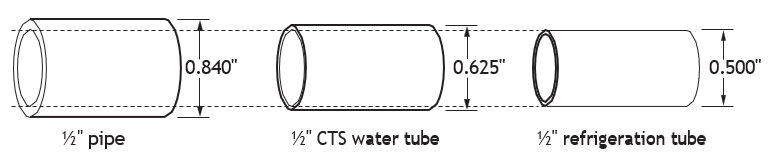
Piping and tubing are described by their nominal pipe sizes (NPS). Nominal pipe sizes are approximate inside diameters measured in inches. Piping and tubing may have the same NPS but have different actual dimensions depending on material. For example, a [latex]\frac{1}{2} \text{"}[/latex] NPS iron pipe, [latex]\frac{1}{2} \text{"}[/latex] NPS copper water tube, and [latex]\frac{1}{2} \text{"}[/latex] NPS refrigeration tube will all have different outside diameters (OD).
For a given NPS, iron piping has the largest outside diameter to ensure that the wall thickness will allow threading (Figure 1).
Pipe Size Standards
Steel and iron were the first materials used in the manufacture of piping. Iron pipe size (IPS) is the original standard developed for piping. It’s still the basic standard for all pipe of any material (e.g., metal, plastic, vitreous clay) that has the same outside diameter and nominal size as the equivalent iron or steel pipe. Iron pipe size standards demand that the outside diameters of a pipe must be the same for all pipe of the same nominal size.
Pipe Thread Standards
Most piping is threaded, and the actual size, depth, angle, and pitch of threads for pipe are set by the National Pipe Thread Tapered (NPT) standard. This ensures that any pipe made to IPS standards will mate with the same threaded fittings.
You will find many different fittings and adapters to connect all types of piping. Copper, steel, and brass pipe (not tubing) as well as ABS and PVC plastic pipe may all be made to the same IPS standard. If the pipes are threaded, they can be joined to each other with IPS threaded fittings, regardless of each component’s material. The effect of electrolytic action will still have to be considered when choosing a fitting to connect different metal pipes.
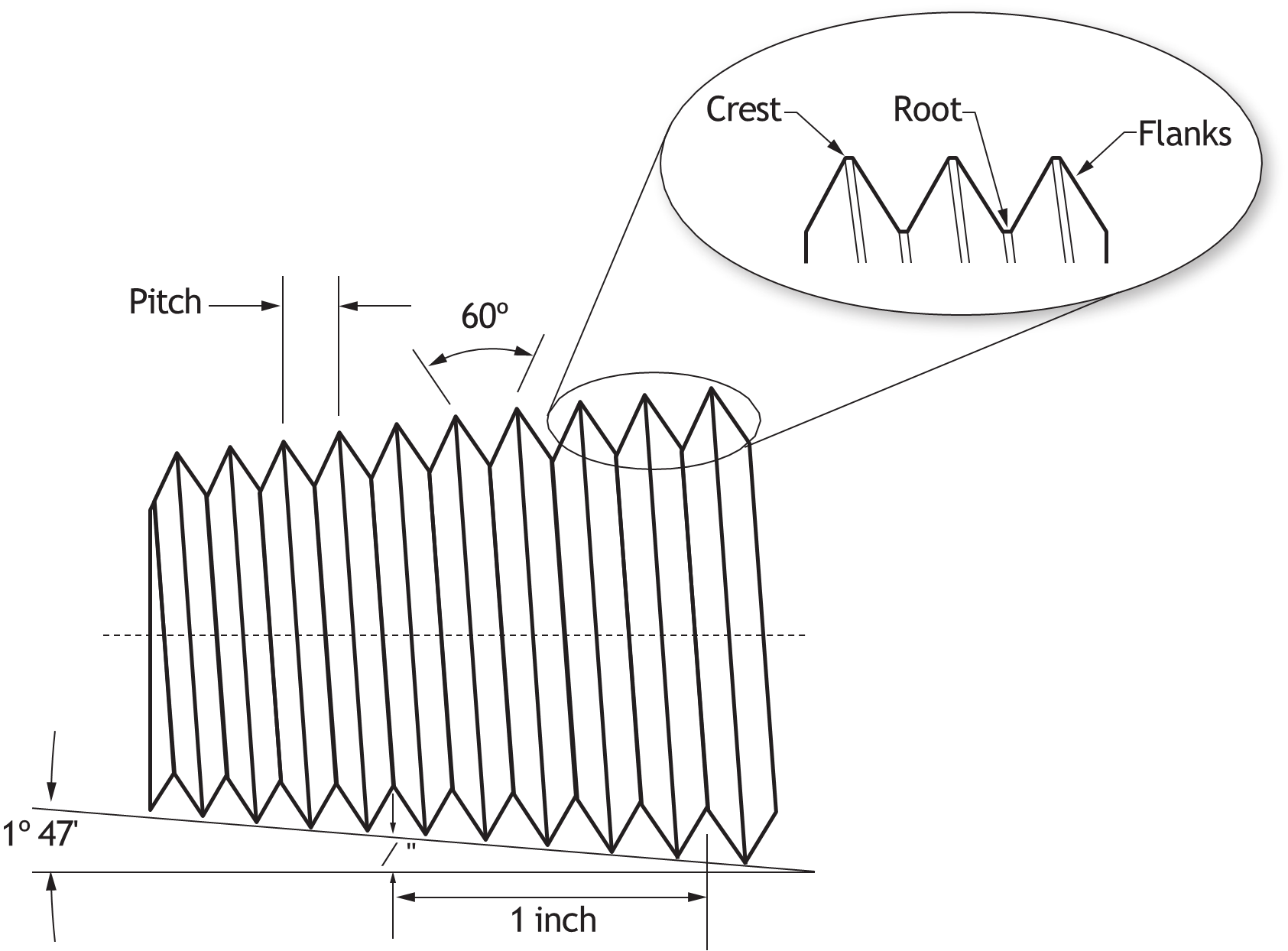
Unlike the straight thread pattern found on bolts, piping used for the delivery of gases or fluids under pressure has a threaded section that narrows to create a seal (Figure 2). This is called a “tapered thread”. The seal provided by a threaded pipe joint depends upon the diminishing seal created by the threads and sometimes on the presence of a sealing coating, such as thread seal tape (Teflon tape), or a liquid or paste applicant such as “pipe dope”. Pipe dopes and tapes are applied to male (external) threads to lubricate the mating of the threads. Pipe dopes and tapes reduce friction, allowing the joint to be properly tightened to specifications without binding.
Unlike straight threads, pipe threads are tapered to create a seal. Sealants such as thread tape or pipe compound are used to prevent leaks.
National Pipe Thread
The standard developed in North America for tapered threads is ANSI/ASME standard B1.20.1 and is known as National Pipe Thread (NPT). It sometimes is still referred to as American Standard Pipe Thread (ASPT).
The rate of taper for all NPT threads is [latex]\frac{1}{32}[/latex]” per inch (1° 47′), and the grooves that create the threads are formed at 60-degree angles. The thread pitch is measured in inches. The root and crest are flat to accommodate thread sealant.
Commonly used threaded pipe sizes are [latex]\frac{1}{8}[/latex], [latex]\frac{1}{4}[/latex], [latex]\frac{3}{8}[/latex], [latex]\frac{1}{2}[/latex], [latex]\frac{3}{4}[/latex], 1, 1[latex]\frac{1}{4}[/latex], 1[latex]\frac{1}{2}[/latex] and 2 inch. Sizes smaller than [latex]\frac{1}{8} \text{"}[/latex] are occasionally used for compressed air, while sizes larger than 2″ are less common, due to the use of alternative methods of joining that are more common with these larger sizes.
The outside diameters of all pipe sizes up to 16″ are listed in Table 1. Note that for nominal pipe sizes (NPS) greater than 12″, the outside diameter is equal to the nominal pipe size.
|
NPS (inches) |
Outside diameter |
Wall thickness |
||
|
Schedule 40 |
Schedule 80 |
Schedule 160 |
||
| 0.5 |
0.840 |
0.109 |
0.147 |
0.187 |
| 0.75 |
1.050 |
0.113 |
0.154 |
0.218 |
|
1 |
1.315 |
0.133 |
0.179 |
0.250 |
|
1.25 |
1.660 |
0.140 |
0.191 |
0.250 |
|
1.5 |
1.900 |
0.145 |
0.200 |
0.281 |
|
2 |
2.375 |
0.154 |
0.218 |
0.344 |
|
2.5 |
2.875 |
0.203 |
0.276 |
0.375 |
|
3 |
3.500 |
0.216 |
0.300 |
0.600 |
|
3.5 |
4.000 |
0.226 |
0.318 |
NA |
|
4 |
4.500 |
0.237 |
0.337 |
0.531 |
|
5 |
5.563 |
0.281 |
0.375 |
0.625 |
|
6 |
6.625 |
0.280 |
0.432 |
0.719 |
|
8 |
8.625 |
0.322 |
0.500 |
0.906 |
|
10 |
10.750 |
0.365 |
0.594 |
1.125 |
|
12 |
12.750 |
0.406 |
0.688 |
1.312 |
|
14 |
14.000 |
0.438 |
0.750 |
1.406 |
|
16 |
16.000 |
0.500 |
0.844 |
1.594 |
You do not have to memorize the dimensions of each NPS category presented in these tables. Review the tables and notice the standard dimensions and how they vary across the different wall thickness standards and between NPS sizes. There are also standards that determine the weight of pipe per lineal foot. The dimensions and wall thickness noted in these tables are only allowed to vary a few percent from the established values.
Standard Wall Thickness
The NPS pipe sizes shown in Table 1 have varying wall thickness, with Schedule 40 pipe having the thinnest walls, and Schedule 160 the thickest. There is also an increase in wall thickness for each larger pipe size. This is due to the need to increase wall thickness as the diameter increases to maintain the same pressure rating of the pipe.
Schedule numbers are modern classifications for the original weight classes of iron and steel pipe (Table 2). Originally, iron pipe was available in two standard weights, and steel piping was available in three weights. For example, cast iron soil pipe was initially sold in service weight (SW) and extra heavy (XH). Steel pipe was made in three weights: standard, extra-strong (heavy), and double extra-strong (extra-heavy). These weight classes were directly related to the wall thickness of the piping and the service application.
In an effort to standardize the increasing range of wall thickness in iron and steel piping, standards agencies developed schedule numbers from 5 to 160. These numbers indicate approximate values of the pressure-stress ratios times 1000. Standard weight steel pipe is equivalent to Schedule 40. Extra-heavy cast iron pipe is equivalent to Schedule 80.
|
Schedule Number |
Weight Classification |
|
40 |
standard weight |
|
80 |
extra-strong (heavy) |
|
160 |
double extra-strong (heavy) |
Stainless steel piping in IPS sizes is classified by a separate class of schedule numbers that range from 5S to 80S.
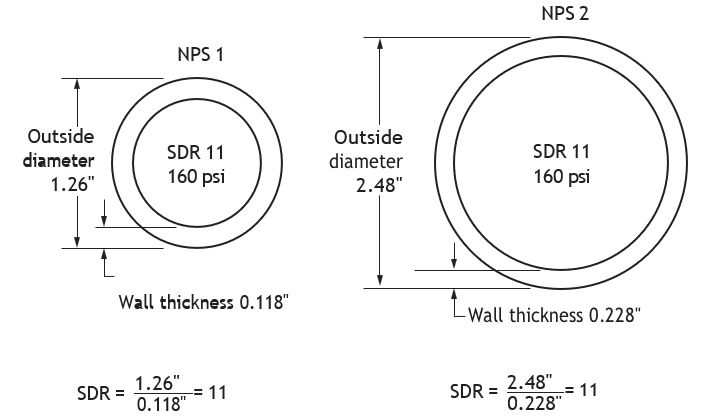
A more versatile standard was developed that directly relates pipe dimensions to pressure ratings. This standard or rating system is called standard dimension ratio (SDR). SDR is the ratio of the average outside diameter to the minimum wall thickness measured in inches.
[latex]\text{SDR} = \frac{\text{outside diameter (OD)}}{\text{minimum wall thickness}}[/latex]
Theoretically, different sizes of piping made of the same material, with the same SDR, should have the same pressure ratings. For example, 1″ and 6″ PVC pressure pipe with an SDR 26 rating are both suitable for 1.1 MPa (160 psi). Figure 3 shows a cross-sectional drawing of two different sizes of plastic pipe: NPS 1 and NPS 2. Each pipe is made of the same kind of plastic. Notice the increased wall thickness of the larger diameter pipe. When the outside diameter is divided by the wall thickness, the ratio or SDR is the same. Each pipe has an SDR of 11, which means that both sizes of pipe can be used at pressures up to 160 psi.
Plastic pipe, such as CPVC and PVC, is sold in a wide range of wall thickness and pipe diameters. The standard schedule classifications are used for piping that matches the dimensions of iron or steel piping. For piping that does not match IPS standards, the SDR classification is preferred.
Each different SDR number has a corresponding pressure rating for each kind of material. For example, one type of polypropylene is available in three SDR ratios:
- SDR 32
- SDR 17.6
- SDR 11
Metal Piping
The previous sections described how pipe is identified and sized using systems such as IPS, schedule numbers, and SDR. These sizing systems apply across many different types of pipe, regardless of the material from which the pipe is made.
Once pipe has been identified by size and pressure rating, it is also classified by the material used in its manufacture. Different materials have different physical, chemical, and mechanical properties that affect their strength, durability, corrosion resistance, and suitability for specific applications.
The following sections introduce the common types of pipe materials used in the piping trades, beginning with metal piping and progressing to specific materials such as copper, steel, and plastics.
Metal piping may be made of pure elements or a mixture of elements called alloys. Alloys are used to improve pipe corrosion resistance, durability, strength, and other qualities.
Copper is an example of a pure metal. Copper tubing is claimed to be 99.9% pure copper.
Bronze is an alloy made of two elements: copper and tin. Brass is another alloy made primarily of copper and zinc.
Piping and Tubing and the Use of Alloying Metals
The chemical, physical, and mechanical properties of many metals are altered by the addition of alloying metals. The range of possible additions and proportions is virtually endless.
For example, iron may be mixed with varying amounts of carbon, silicon, manganese, sulphur and phosphorus to improve the pipe or tubing resistance to corrosion.
Nickel, chromium, magnesium, molybdenum, titanium and vanadium are all substances that will increase the hardness and tensile strength of a pipe. Chromium, nickel and titanium will increase an alloy’s resistance to corrosion or staining. Tungsten and molybdenum will increase the melting point of all metals.
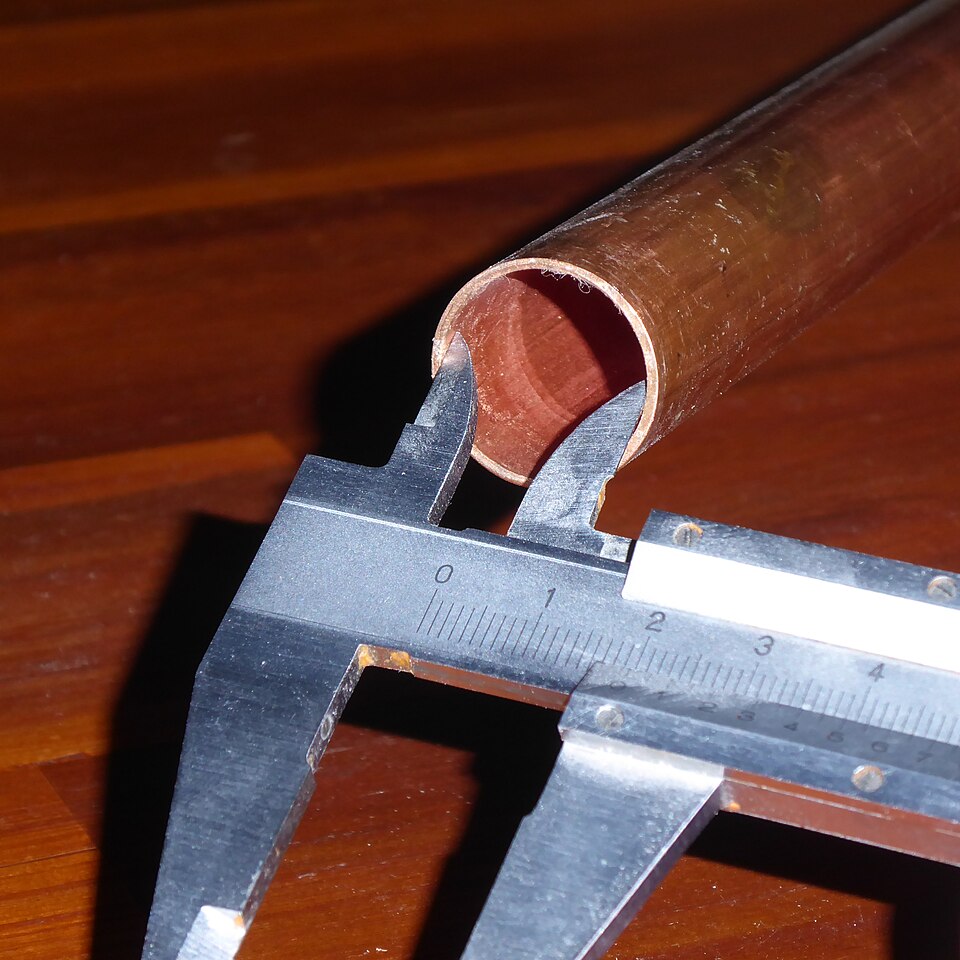
Copper Tubing
Copper piping and tubing is made from 99.9% pure copper. Copper piping is used in underground water service, hot and cold potable water systems, hot water heating systems, refrigeration and DWV systems.
Copper piping and tubing has the following characteristics:
- Does not rust
- Smoothness of interior (even at fittings)
- Manufactured with various wall thickness but standard outside diameters
- Available in hard tubing or available in soft (annealed) tubing that is very flexible
- Lightweight, malleable, and easy to work with
- Copper potable water tubing is available in sizes from [latex]\frac{1}{4} \text{"}[/latex] –12″
- Copper DWV tubing is available in sizes from 1 [latex]\frac{1}{4} \text{"}[/latex]– 8″
 See IPT’s Pipe Trades Handbook and Manual for examples of other pipes with print lines.
Nickel and Nickel Alloys and Uses
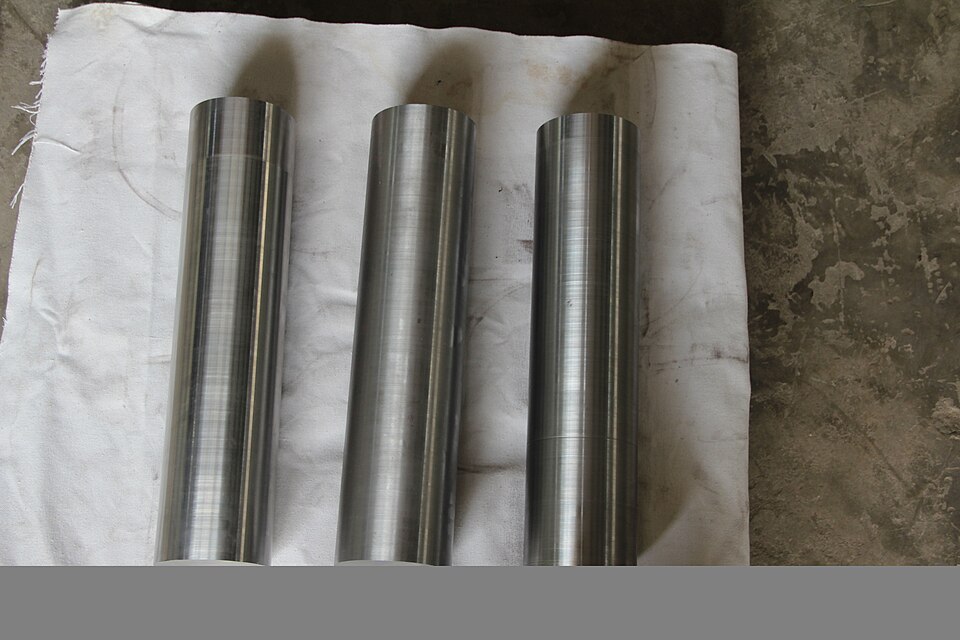
Nickel and nickel alloys are used in heavy industry such as marine and ship building, pulp and paper manufacturing, medical gas systems, and chemical manufacturing. Nickel and copper nickel alloys come in several types.
The basic metals used are copper and nickel—other metals are added in varying proportions. The different alloys of copper nickel have different characteristics tailored to specific installation environments. The examples of nickel and copper nickel provided in this information are only a partial list of types and uses. Further information about alloys can be found on manufacturers’ websites.
There are several grades of nickel piping including:
- Nickel pipe 200 ASTM/ASME SB standard
- Nickel pipe 201 ASTM/ASME SB standard
- Nickel pipe 205 ASTM/ASME SB standard
Monel is a nickel alloy and is produced in grades such as Monel 200, 400, and K 500 ASTM/ASME SB standard. Monel alloy uses include:
- Chemicals, fats, and fertilizers manufacturing
- Sugar mills and distilleries
- Cement industries
- Shipping
- Paper industries
- Pumps
Inconel is a nickel alloy and is produced in grades such as Inconel, 600, 601, and 825 ASTM/ASME SB standard. Inconel characteristics include:
- Nonmagnetic
- Corrosion- and oxidation-resistant
- Strong and durable structure
- Butt-weld and forged fittings available or can be manufactured with short lead times
Hastelloy is a nickel alloy and is produced in grades such C-22, C-276 (UNS N10276) standard pipe ASTM/ASME.
Hastelloy uses include:
- Marine, power, chemical processing, pollution control, paper processing, waste disposal
- Sour gas applications (NACE MR0175)
- Flue gas desulfurization (FGD) applications for scrubbers, dampers and ducts
Hastelloy C-22 tubing is available up 2″ OD in welded and [latex]\frac{1}{2} \text{"}[/latex] OD seamless construction. Seamless pipe is available up to 6″. Larger sizes are available in welded construction.
Copper Nickel Alloy Types
Copper nickel alloy type ASTM B111 90-10 is widely used in sea water applications. It has very good corrosion resistance to clean or moderately polluted water.
Copper Nickel Alloy Type
ASTM B111 70-30 is preferred for severe operating conditions. It has excellent resistance to impingement and erosion-corrosion by suspended solids in sea water. 70- 30 copper nickel is virtually immune from stress-corrosion cracking. It can be sensitive to deposit attack and is therefore not recommended for stagnant or slow-moving water.
Copper Nickel Alloy Uses
Copper nickel alloy has the following uses:
- Water desalination plants, especially in the most critical areas such as the heat reject and brine heater stages of power station condensers
- Chemical, petrochemical, and food processing industries
- Applications where top surface corrosion resistance is required
- Sea water corrosion-resistant assemblies
Brass Pipe
Brass piping is made from varying proportions of copper and zinc. Brass piping is very expensive. It is used in some hot and cold water supply lines and some drainage systems.
Brass pipe has the following characteristics:
- Versatile
- Very soft so can be threaded easily
- Very resistant to corrosion and rust
- Smooth inner walls reduce blockages in piping
- Can withstand high pressures (up to 7 MPa or 1000 psi)
- Difficult to puncture
- More ductile than copper and bronze
Brass pipe is available in sizes ranging from [latex]\frac{1}{8}[/latex] – 12″ (same sizing as steel piping) and standard lengths of 6 m (20′).
Aluminum Pipe and Tubing
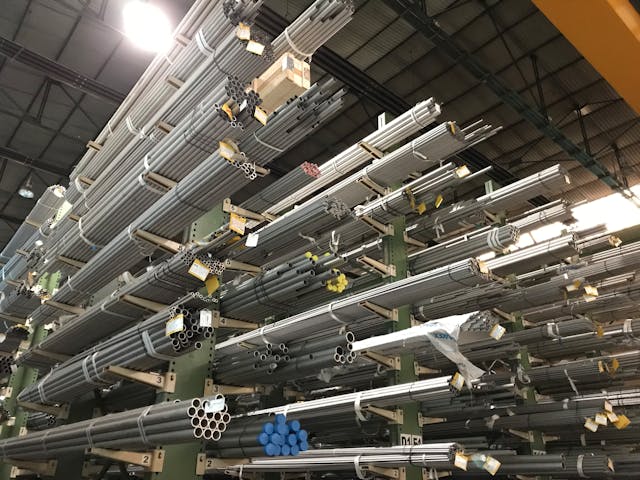
Seamless aluminum piping is inexpensive and used primarily in irrigation systems. It is permitted in drainage systems if it is lined with plastic and in above-ground venting systems. This pipe was used in DWV systems for a short time but is no longer acceptable according to current plumbing codes.
Aluminum DWV pipe:
- Must be protected from corrosion
- Has relatively high tensile strength
- Lightweight, malleable, and ductile
Cast Iron Piping (Cast Iron Soil DWV Pipe)

Cast iron piping, sometimes referred to as mechanical joint or MJ, is an alloy of iron, carbon, and silicon. It may also contain varying amounts of manganese, sulphur and phosphorus to increase its corrosion resistance. Grey cast iron piping is used in drainage, sewer, and venting systems. Cast iron soil pipe cannot be used in a potable water system.
Cast iron piping qualities include:
- Resists corrosion; non-flammable
- Coated with pitch to protect from rust
- Durable and relatively inexpensive
- Does not easily transmit the sound of running water; much quieter than copper or plastic
- Heavier than plastic or copper
- Withstands high temperatures but not high pressures
- No-hub cast iron soil pipe is supplied in 3 m (10′) lengths
Ductile Cast Iron Water Pipe (Ductile Water Main)
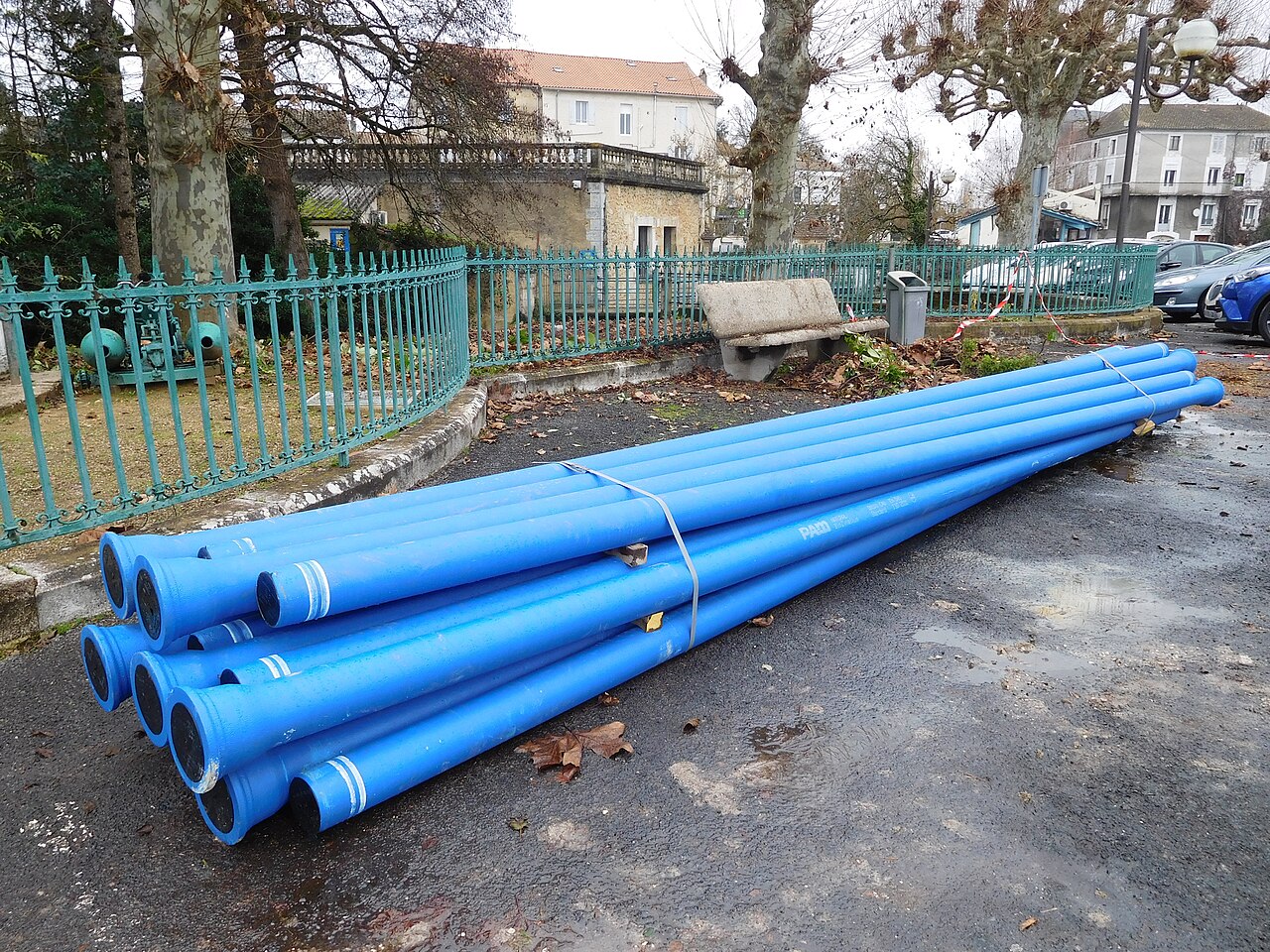
Ductile iron pipe is a type of cast iron pipe used for potable water distribution. It’s made from ductile iron. Ductile cast iron is produced by a technique known as centrifugal casting. The molten ductile iron is poured into a rapidly spinning water-cooled mold. Centrifugal force causes the molten iron to spread evenly around the circumference of the mold. Ductile iron will resist corrosion, however, over longer periods of time, the build-up of corrosion products inside the pipe can restrict the flow. Ductile cast iron water main is lined with a portland cement and sand mix mortar. The mortar is centrifugally applied during manufacturing. The mortar lining extends the life of the water main. A variety of other linings are available to reduce or eliminate corrosion including polyurethane and polyethylene. The exterior of the pipe is coated with bituminous coating to protect the pipe during shipping and installation.
In some jurisdictions, the ductile iron can be wrapped in a polyethylene sleeve. The sleeve of polyethylene completely wraps the pipe and the bell of any joints. The sleeve inhibits galvanic corrosion by physically separating the pipe from the surrounding soils.
Ductile water main characteristics:
- Very strong
- Fracture-resistant
- Nominal pipe sizes vary from 3 – 64″, in increments of at least 1 inch
- Manufactured exclusively from scrap steel
- Can be recycled
Spigot and sockets involve a normal pipe end (the spigot) being inserted into the socket (or bell) of another pipe or fitting. This is called a “push-joint” or “slip-joint”. A gasket and the pipe are lubricated before assembly. The joints provide some flexibility, allowing the pipe to resist ground movement stresses. Any bends, tees, or valves will require either a restrained joint or, thrust blocks.
Duriron Pipe
Duriron pipe is a high-silicon-content acid-resistant cast iron pipe. It’s available in hub and spigot ends or mechanical joint no hub ends. Duriron pipe and fittings can be used wherever acids, solvents, bleaches, detergents, or otherwise aggressive fluids are present. Duriron is ideal for use in chemical processing plants, school, and industrial laboratories.
Duriron characteristics:
- Outstanding corrosion resistance
- Excellent resistance to sulfuric, nitric, hydrochloric and acetic acids
- Resistant to both oxidizing and reducing solutions
- Is not appreciably affected by either acid concentration or temperature
- Tensile strength is less than most metals
- Suitable for applications up to 500°F (260°C)
- High abrasion resistance
- Density and wall thickness muffles sound from drainage
- Bell & spigot pipe is available in 2-inch through 15-inch diameters
- Mechanical joint pipe and fittings is available in 1[latex]\frac{1}{2} \text{"}[/latex]-inch through 4-inch
- Available in a split flange deign in sizes 1-inch to 8-inch
Duriron bell & spigot joints should be assembled using virgin lead and Red Stripe Sealite A312 acid- resistant rope packing. Mechanical joint couplings should be installed by alternately tightening the two nuts and bolts to a minimum of 9 ft-lbs and a maximum of 11 ft-lbs torque.
Wrought Iron Piping
Wrought iron pipe was used for water supply in older houses. It comes either “black” or galvanized. Joints are made by threading pipe into cast iron fittings—unlike screw threads, pipe threads are tapered. Wrought pipe can be identified by a raised cross-hatch pattern on one side or the other. Wrought iron pipe is no longer used in water systems.
Carbon Steel Pipe
Carbon steel is steel where carbon is the main alloy component. Carbon steel pipe is commonly referred on the job as “black iron pipe.” Carbon steel pipe manufactured with a zinc coating is called galvanized iron pipe. Carbon steel pipe can also be manufactured with a plastic coating for use in corrosive environments or underground. Carbon steel pipe is used in steam and hot water heating systems, fuel-gas piping systems and fire sprinkler systems.
Carbon Steel Types
ASTM A53 is a carbon steel alloy used for structural steel pipe. The alloy specifications are set by ASTM International, in specification ASTM A53/A53M [1]. A53 pipe is suitable for structural or pressure applications. A53 pipe comes in three types and two grades:
- A53 Type F is longitudinally furnace butt welded or continuous welded (Grade A only).
- A53 Type E is longitudinally electric resistance welded (Grades A and B).
- A53 Type S is seamless pipe, produced by hot working, and possibly cold finishing, the steel (Grades A and B). ASTM A53 Type S is now currently an outdated specification and has been replaced by ASTM A106 specification for seamless carbon steel pipe.
▸ Available from [latex]\frac{1}{8} \text{"}[/latex] – 48″ diameter and larger, from stock, in Schedule 5 through Schedule 160, standard, extra-heavy, and double extra-heavy.
▸ Threaded, bevelled, and grooved ends available from stock.
▸ Tube and tubing in carbon, stainless steel, aluminum and other alloys in sizes from hypodermic to 48″ and larger. Available in rigid lengths and coils, depending on application.
Seamless Steel Pipe and Tubing
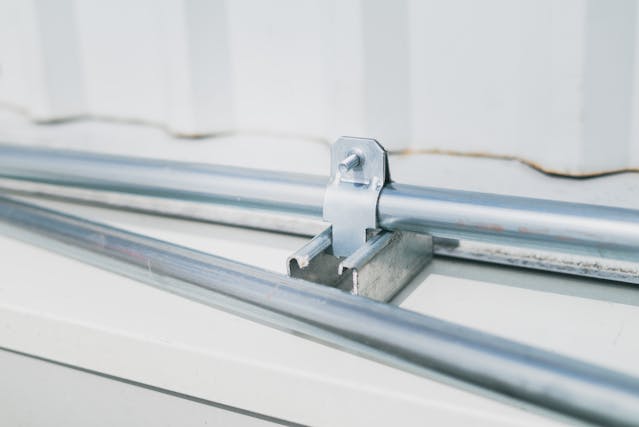
Seamless (SMLS) steel pipe is made from a solid round steel billet that is heated and pushed or pulled over a form until the steel is shaped into a hollow tube. The seamless pipe is then finished to dimensional and wall thickness specifications. Seamless steel finishes include hot rolled, cold drawn, turned, and roto-rolled. After the end finishing is complete, all pipes are then pressure- tested. A final visual inspection and labelling is completed, and an external coating can then be applied.
Characteristics of seamless steel pipe:
- Used for steam boilers and pipelines for installations with high and supercritical steam conditions
- Used in oil and gas, chemical, and automotive industries
- Ultra strength and durability
- Can be used for corrosion-resisting applications
- In sizes from [latex]\frac{1}{8} \text{"}[/latex] – 26″ OD
- ASTM A106/A106M – 10 standard specification for seamless carbon steel pipe for high- temperature service
Stainless Steel
Stainless steel is used primarily when corrosion or oxidation is a problem. Over 50 years ago, it was discovered that the addition of chromium to steel would impart corrosion and oxidation resistance to the steel.
Stainless steel is available from [latex]\frac{1}{8} \text{"}[/latex] – 24″ diameter in Schedule 5 through to double extra-heavy and beyond. Also available is an inside diameter pulp and paper specified pipe.
Specialty grades are available, including high-nickel alloys such as Hastelloy C-276; carbon alloys such as Chrome-Moly P22, WPL6; aluminum alloys such as 6061T6, 5083H112; and stainless alloys such as 317L, 321, and 347.
Stainless steel alloys usually have a chromium content of at least 10%.
Grades of Stainless Steel
There are different grades of stainless steel:
- Austenitic: these grades (such as 302, 304, 308, 316, etc.) are also available with a lowered carbon content (designated with an “L”, such as 304L or 316L).
- Martensitic (such as 410 and 416).
- Ferritic (such as 409 and 430).
Depending on the grade, stainless steel is made up of iron and:
- Carbon (approximately 3–10%)
- Nickel (0–22%)
- Chromium (4–27%)
- Molybdenum (0 –4%)
Qualities of stainless steel:
- Corrosion-resistant
- Oxidation-resistant
- Heat-resistant
- Improved strength
Identify Stainless Steel Grades
Austenitic Grade of Stainless Steel (300 Series)
Austenitic grades are those alloys that are commonly in use for stainless applications. The austenitic grades are not magnetic. The most common austenitic alloys are iron-chromium- nickel steels, widely known as the 300 series. The austenitic stainless steels, because of their high chromium and nickel content, are the most corrosion-resistant of the stainless group, providing unusually fine mechanical properties. They cannot be hardened by heat treatment but can be hardened significantly by cold-working.
Straight Grades
The straight grades of austenitic stainless steel contain a maximum of 0.08% carbon. There is a misconception that straight grades contain a minimum of 0.03% carbon, but the specification does not require this. As long as the material meets the physical requirements of straight grade, there is no minimum carbon requirement.
L Grades
L grades of austenitic stainless steel are used to provide extra corrosion resistance after welding. The letter L after a stainless steel type indicates low carbon (as in 304L). The carbon is kept to 0.03% or under to avoid carbide precipitation. Participation of carbon in stainless steel occurs when the steel is heated to temperatures in the critical range (800 – 1600°F). The carbon moves to the welded area and combines with the chromium resulting in reduced corrosion resistance of the welded joint.
- L grades are more expensive.
- L grades are used where annealing after welding is impractical, such as in the field where pipe and fittings are being welded.
H Grades
H grades of austenitic stainless steel contain a minimum of 0.04% and a maximum of 0.10% carbon and are designated by the letter H. H grades are primarily used when the material will be used at extreme temperatures, because the higher carbon helps the material retain strength at extreme temperatures.
Martensitic Grades of Stainless (400 Series)
The martensitic grades are straight chromium steels containing no nickel (414 has 2% nickel).
Martensitic grades of stainless steel were developed to provide a group of stainless alloys that would be corrosion-resistant and hardened by heat treating. They are magnetic.
The martensitic grades are mainly used where hardness, strength, and wear resistance are required.
Ferritic Grades of Stainless Steel (400 Series)
Ferritic grades have been developed to provide a group of stainless steel to resist corrosion and oxidation, while being highly resistant to stress corrosion cracking. These steels are magnetic but cannot be hardened or strengthened by heat treatment. They can be cold-worked and softened by annealing. As a group, they are more corrosion-resistant than the martensitic grades but are generally inferior to the austenitic grades. Like martensitic grades, these are straight chromium steels with no nickel. They are used for decorative trim, sinks, and automotive applications, particularly exhaust systems.
Corrugated Steel
This piping is used mainly for municipal applications such as storm sewers, storm water drainage, under-drains, culverts, and similar uses.
Corrugated pipes are not normally used for the conveyance of sanitary or industrial wastes.
Plastic Pipe and Tubing
It’s important to be able to identify and install plastic pipe and tubing. Plastic piping is increasingly popular because of its versatility and ease of installation. Some codes limit its use in water supply piping within buildings. Plastic materials are generally divided into two groups: thermoplastics and thermosetting resins. Thermoplastics (such as ABS and PVC) can be repeatedly reformed by heating. Thermosetting resins (such as fibreglass) cannot be reshaped after they have been formed and cured. Most plastic piping materials are thermoplastics.
Polyethylene Plastics
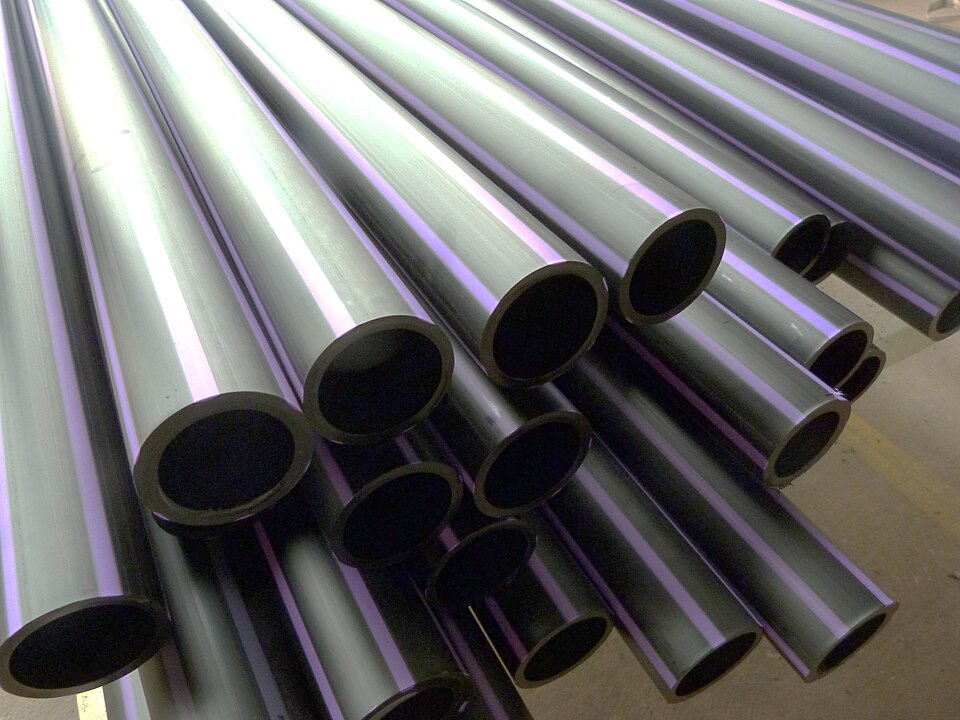
Polyethylene thermoplastic is made from petroleum. The method of processing determines the type of polyethylene used for different purposes including piping and tubing. Piping made from polyethylene is a cost-effective solution for a broad range of piping problems in municipal, industrial, marine, mining, landfill, duct, and agricultural applications. It has been tested and proven effective for above ground, surface, buried, floating, and sub-surface marine applications. Polyethylene (PE) is widely used in underground water and gas service and field irrigation systems. Cross-linked polyethylene tubing is used for water supply systems and hydronic heating.
Polyethylene piping has the following characteristics:
- Usually black (to prevent breakdown from sunlight) but also available in yellow or orange
- Extremely high-impact strength, yet flexible enough to be coiled
- High resistance to chemicals
- Low melting point and low temperature resistance, up to 54°C (130°F)
Polyethylene Pipe Qualities
In most piping systems, aging increases the pipe surface roughness, which increases flow resistance. Polyethylene (PE) pipe resists typical aging because it does not rust, rot, corrode, tuberculate, or support biological growth—it also resists the adherence of scale and deposits. In some cases, moderate flow velocities are sufficient to prevent deposits. For systems using a low velocity, it may be enough to introduce occasional high velocity flow in order to remove sediment and deposits.
Low-flow-rate gravity-flow pipelines can be cleaned with a water-jet or by forcing a soft (plastic foam) pig through the pipeline. Don’t use bucket, wire, and scraper-type cleaning as these methods can damage PE pipe.
There are several types of polyethylene used to manufacture polyethylene pipe, including:
- High-density polyethylene (HDPE)
- Medium-density polyethylene (MDPE)
- Low-density polyethylene (LDPE)
- Linear low-density polyethylene (LLDPE)
You are not expected to memorize all types—focus on general properties and applications.
High-Density Polyethylene (HDPE)
High-density polyethylene or polyethylene high-density (PEHD) is a polyethylene thermoplastic made from petroleum. HDPE’s plastic identification code (PIC) is 2. A plastic product’s PIC is the small number printed within the recycling diagram somewhere on its surface. The HDPE has benefited from discussions about possible health and environmental problems caused by PVC and polycarbonate associated Bisphenol-A. HDPE’s main use has been for underground gas piping.
Medium-Density Polyethylene (MDPE)
MDPE is less dense than HDPE. MDPE has good shock and drop-resistance properties. Stress cracking resistance is better than that of HDPE. MDPE is typically used in shrink film, packaging film, carrier bags, and screw closures. MDPE may be used for gas pipe and fittings when approved for that use.
Low-Density Polyethylene (LDPE)
LDPE is a thermoplastic made from petroleum. LDPE is commonly recycled and its “recycling number” (PIC) is 4. LDPE is used to manufacture juice and milk cartons, playground slides, and plastic wraps. LDPE is not used for piping.
Linear Low-Density Polyethylene (LLDPE)
LLDPE has penetrated almost all traditional markets for polyethylene—it’s used for plastic bags and sheets, plastic wrap, stretch wrap, pouches, toys, covers, lids, pipes, buckets and containers, covering of cables, and flexible tubing. (It can be made much thinner than LDPE.)
LLDPE can be recycled into other things such trash can liners, lumber, landscaping ties, floor tiles, compost bins and shipping envelopes.
The following are examples of polyethylene materials used in the piping industry. Refer to the manufacturer’s specifications for the product to ensure that the pipe you use meets the appropriate standards, applicable code requirements, and job specifications.
There are several categories of polyethylene pipe:
- CSA series, for building/plumbing code-related installations
- Standard series for non-CSA applications.
- Other polyethylene pipe products lines for specialty installations such as geothermal, ice rinks, submersible pump drop, irrigation, storm drainage, National Sanitation Foundation (NSF) uses, and utility uses
CSA Series Polyethylene Piping
The CSA series of polyethylene is general purpose pipe. It’s available in either low-density polyethylene (LDPE) or high-density polyethylene (HDPE) grades manufactured to CSA B137.1 standards.
CSA Series 75 PSI B137.1
This is a general light-duty service suitable for potable water.
Characteristics:
- Lightest wall thickness
- Black in colour
- Limited to 75 psi at 73.4°F
- Joined with gear clamps and insert type fittings
- Available in coils from 100′ – 500′ and reels up to 3000′
- Not allowable for use within the scope of the Plumbing Code
- Available in sizes [latex]\frac{1}{2}[/latex]-inch to 2-inch
- Carbon black pigment for ultraviolet protection
CSA Series 100 PSI B137.1
This is a general-duty service suitable for potable water. Characteristics:
- Heavier wall thickness than series 75 PSI
- Manufactured from LDPE
- Black in colour
- Limited to 100 psi at 73.4°F
- Joined with gear clamps and insert type fittings
- Available in coils from 100 ‘– 500′ and reels up to 3000’
- Not allowable for use within the scope of the Plumbing Code
- Available in sizes [latex]\frac{1}{2}[/latex]-inch to 2-inch
- Carbon black pigment for ultraviolet protection
CSA Series 160 PSI Copper Tube Size (CTS) B137.1 Municipal Water Service
CSA series 160 polyethylene pipe is specifically used for water service piping. Series 160 is copper tube size (CTS). It has its own size designation and will not accept normal polyethylene insert fittings, although fittings are available to adapt from one to the other. A yellow stripe that runs the full length of the pipe identifies some manufacturers’ series 160 pipe. The yellow stripe is part of the pipe wall and permanently identifies it as the specific manufacturer’s pipe.
In Canada, polyethylene water pipe and fittings must be certified to CAN/CSA-B137.1, Series 160, with a rated working pressure of 1034 kPa (150 psi).
Characteristics:
- Non-corroding and resists most acids, salt solutions, alkalis, fats, and oils
- Black or black with a yellow stripe
- Available in 100′, 200′, and 500′ coils as well as in 1000′ reels.
- Manufactured to copper tube size (CTS)
- Will not accommodate normal polyethylene insert fittings
- Resists decomposition, oxidation, tuberculation and microbiologically induced corrosion
- Connections of brass or plastic compression fittings are readily available
- Requires a stainless steel insert or a specially designed (copper tube size) plastic insert to reinforce the pipe joints
- Sequential markings every two feet
- Expansion rate is 0.87″ per 100′ of pipe for every 10°F change
- Rated at 160 psi @ 72°F cold water use only
- Plumbing Code restricts the use to a water service only
CSA Series 200 PSI Copper Tube Size (CTS) B137.1 Municipal Water Service
Characteristics:
- Non-corroding and resists most acids, salt solutions, alkalis, fats and oils
- Black in colour
- Manufactured from HDPE
- Available in 100′, 200′, and 500′ coils as well as in 1000′ reels
- Manufactured to copper tube size (CTS.)
- Will not accommodate normal polyethylene insert fittings
- Resists decomposition, oxidation, tuberculation and microbiologically induced corrosion
- Connections of brass or plastic compression fittings are readily available
- A stainless steel insert or a specially designed (copper tube size) plastic insert to reinforce the pipe joints
- Sequential markings every two feet
Non-CSA Standard Polyethylene Pipe
Non-CSA standard polyethylene is used in water distribution applications that do not require CSA approval.
Standard Series 75 PSI LDPE
Characteristics:
- Black in colour
- Manufactured from low-density polyethylene
- Available in sizes [latex]\frac{1}{2}[/latex]-inch to 2-inch
- Available in 100’–500′ coils and 1000–3000′ reels
- Limited to 75 psi at 73.4°F
- Joined with gear clamps and insert-type fittings
Standard Series 100 PSI LDPE
Characteristics:
- Black in colour
- Manufactured from low-density polyethylene
- Available in sizes [latex]\frac{1}{2}[/latex]-inch to 2-inch
- Available in 100 ‘–500′ coils and 1000–3000’ reels
- Limited to 100 psi at 73.4°F
- Joined with gear clamps and insert-type fittings
Other Polyethylene Applications
The following describe some other polyethylene tubing applications.
Ice Rink PE Linear Low-Density Polyethylene or Low-Density Polyethylene
Manufactured using extrusion method in accordance with CSA-B137.1.
Characteristics:
- Working pressure 70 psi at 73.4°F (23°C)
- 1-inch diameter
- Black in colour
- Limited to 70 psi at 73.4°F
- Available in 2000’–5000′ reels only
- Available in two wall thickness: standard wall and thin wall
Polyethylene Medium-Density Gas Pipe
Characteristics:
- Durable
- Corrosion resistance
- Not affected by hydrocarbons
- CSA B137.1 for water pipe and B137.4 for gas pipe
- Canadian General Standards Board CGSB 41 and 61 pipe polyethylene for transport of liquids
- NSF and Plastic Pipe Institute PPI PE 2406
- Available in a variety of sizes in coils or limited straight lengths
- Limited to 100 psi at 73.4°F
- Yellow in colour
Geothermal HDPE
Geothermal HDPE is manufactured by extrusion from high-density polyethylene (HDPE). Characteristics:
- Durability
- Stress crack resistance
- Sizes from [latex]\frac{1}{2}[/latex]–24″
- Pipes come in sticks, coils, and large reels
- Green in colour (black )
- Limited to 160 psi at 73.4°F
- NSF standard
Marking example for a geothermal HDPE pipe, printed with yellow permanent print stating the following:
- NSF geothermal logo
- Identification manufacturer
- The appropriate SDR rating
- Product trade name
- All relevant standards
- Manufacturing date
- Incremental footage marking every two feet
- Design temperature rating
- Production shift designation
- Identification of PE-3408 high-density resin
Pump Drop Polyethylene
Pump drop polyethylene pipe for submersible pump installations has two use designations:
LLDPE 200′ Depth Installations
- Manufactured by extrusion to CSA B137.1 standard Series 75 and 100
- Up to 200′ deep
- Available in coils from 300–1500 feet
- Available from [latex]\frac{1}{2}[/latex]-inch to 2-inch
- Blue in colour
- Pipe marking includes a printed count-down numbering on the pipe
MDPE 600′ Depth Installations
- Manufactured by extrusion to CSA B137.1 standard Series 160
- Up to 600′ deep
- Available in coils from 300–1500 feet
- Available from 1-inch to 1[latex]\frac{1}{4}[/latex]-inch
- Blue in colour
- Pipe marking includes a printed count-down numbering on the pipe
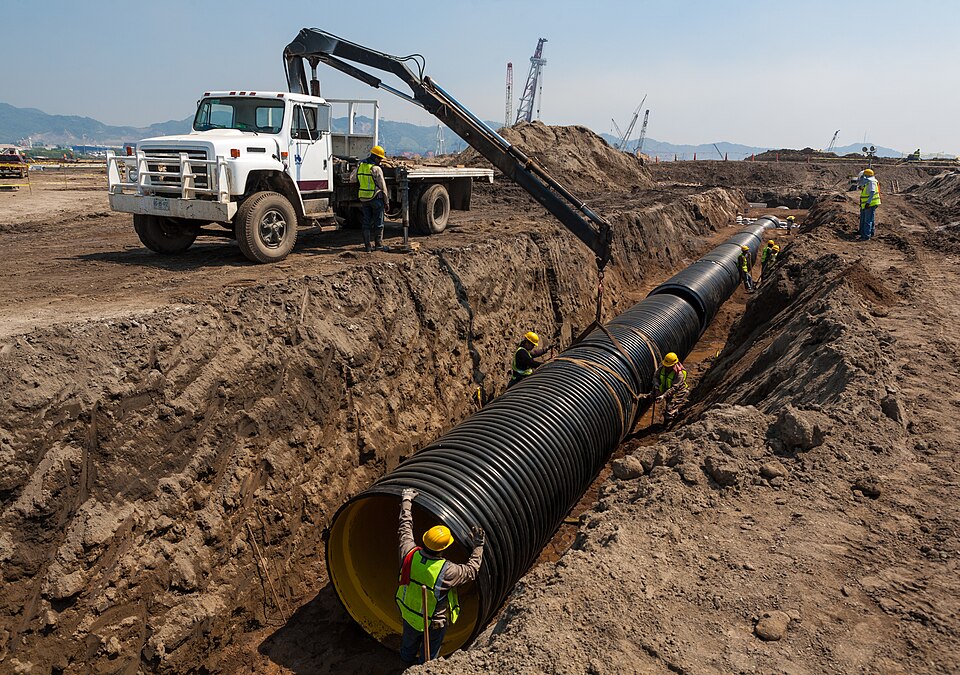
Corrugated HDPE Municipal Storm Drainage
Dual-Wall HDPE Corrugated Pipe for Municipal Storm Drainage
HDPE corrugated municipal storm drainage pipe is manufactured from HDPE. It is available to move stormwater and wastewater.
Characteristics:
- Flexible pipe
- Durability
- Joint integrity
- Long-term cost-effectiveness
- Ability to support and distribute live and dead load Contact manufacturers for approval standards.
Cross-Linked Polyethylene (PEX Tubing)
Cross-linking is a chemical reaction that occurs between polyethylene polymer chains. Currently, three methods for producing cross-linked polyethylene (PEX) tubing exist:
- Engel or peroxide method (PEX-A)
- Silane method (PEX-B)
- E-beam (electron beam) or radiation method (PEX-C)
All three processes generate tubing that is cross-linked to varying degrees, and all meet the ASTM, NSF and CSA standards for use in potable water and heating applications.
Engel Method (PEX-A)
The PEX tubing industry considers this tubing superior because the cross-linking is done during the manufacturing process when polyethylene is in its amorphic state (above the crystalline melting point). Because of this, the degree of cross-linking reaches around 85%, resulting in a more uniform product with no weak links in the molecular chain.
Silane Method (PEX-B)
PEX-B tubing is crosslinked after the extrusion process by placing the tubing in a hot water bath or steam sauna. The degree of crosslinking for PEX-B is typically around 65 to 70%. This method is not as evenly cross-linked as the PEX-A method, nor does it have the same degree of thermal memory, which allows kinked tubing to be reshaped with the use of a heat gun.
E-beam Method (PEX-C)
PEX-C uses an electron beam to change the molecular structure of the tubing (i.e., cross-link) after the extrusion process. The PEX-c method requires multiple passes under the beam to reach a 70 to 75% degree of cross-linking. Side effects of this process are discolouration due to oxidation (from natural white to yellow, unless other pigment is added), and a slightly stiffer product.
PEX-A Distinctions
The properties in PEX-A tubing make it the most flexible PEX on the market. This allows the tubing the tightest bend radius available—as little as 3[latex]\frac{1}{2} \text{"}[/latex] for [latex]\frac{1}{2} \text{"}[/latex] tubing. Its flexibility also greatly reduces the instance of kinked tubing. If there is the occurrence of kinked tubing, PEX-A tubing has thermal memory. This allows the repair of kinked tubing with a careful shot of heat from a heat gun. Shape memory allows PEX-A tubing to expand and then shrink back to normal size, this offers unique opportunity for various types of fitting connections.
Colour Coding of PEX Tubing
The colours used for PEX tubing vary from opaque, white, blue, red and variations of these colours. The best way to identify PEX is via the pipe markings. Typically, red PEX tubing is used for hot water while blue is used for cold.
PEX characteristics:
- Typically has less internal friction than metal pipe
- Less expensive than metal pipe
- Flexible and can be bent into a radius angle to provide less restrictive flow
- Expected lifetime of upward of 50 years
- Susceptible to ultraviolet degradation when exposed to direct sunlight See IPT’s Pipe Trades Handbook and Manual.
Oxygen Barrier PEX
PEX tubing used in radiant heating system applications with ferrous metal parts was found to allow oxygen absorption through the PEX tubing wall. The solution to this problem is to apply an oxygen barrier shield during the manufacturing process. This shield is a thin layer of plastic film that slows down the rate of oxygen diffusion through the piping walls. It doesn’t prevent diffusion. This PEX
tubing is identified by markings such as “OXY guard” or “Oxygen barrier.”
Composite Metal and Plastic Piping
Two kinds of composite metal and plastic piping are:
- Polyethylene/aluminum/polyethylene (PE/AL/PE)
- Cross-linked polyethylene/aluminum/cross-linked polyethylene (PEX/AL/PEX)
Both of these polyethylene composite pipes have three layers. The inside and outside layers are made of high-density polyethylene, tightly bonded with melt adhesive to the mid-layer, the longitudinally overlapped welded aluminum core. All layers are co-extruded in a one-step patented manufacturing process. The polyethylene inside and outside layers are hygienic, non-toxic and smooth. Its middle layer of aluminum serves as an oxygen barrier, stopping the oxygen diffusion through the cross-linked polyethylene layers.
Characteristics:
- Holds a bend better, because the shape memory of the PEX is offset by the aluminum.
- The pipe is available in [latex]\frac{1}{2}[/latex]-, [latex]\frac{5}{8}[/latex]-, [latex]\frac{3}{4}[/latex]– and 1-inch (14, 16, 20, and 25 mm) nominal diameter sizes.
- Available in 3.7 m (20′) straight lengths or coils up to 305 m (1000′).
- Hot-water piping is orange and cold-water piping is blue.
- Joints buried in concrete are not recommended—consult manufacturers’ documentation.
Standards:
- PEX/AL/PEX pipe must comply with ASTM F 1281-98a.
- Produced from polyethylene compound complying with the requirements of ASTM D 1248 for P33, Class A material.
- Grade 3003 aluminum must comply with the requirements of ASTM B 209.
- Both PE/AL/PE and PEX/AL/PEX pipe and fittings used for potable water systems must conform to CAN/CSA-B137.9.
- PE/AL/PE pipe and fittings must not be used in a hot water system.
Pipe markings, at minimum 1.5 m (5′) intervals, include:
- Manufacturer’s name
- Product designation (name)
- Material designation (PEX/AL/PEX) or (PE/AL/PE)
- Nominal size
- Potable water designation
- Appropriate standard designation (CAN/CSA-B137.10)
- Pressure and temperature limitations
Polyamide
Polyamide (PA) is a newer thermoplastic piping material used for underground fuel gas distribution such as natural gas. The PA piping systems possess a higher hydrostatic stress rating than the traditional PE piping systems. Like PE piping systems, PA systems are available in a broad array of sizes and with a full complement of fittings. The PA piping systems are joined using heat fusion methods. PA is typically yellow in colour, which has become the standard for underground gas lines.
Standards: CSA B137.12-09 Polyamide-11 (PA-11) piping systems for gas services
Characteristics:
- Durable
- Available in straight lengths of 164 m (50′) or in coils to more than 76 m (250′)
- Extruded in diameters ranging from 2 – 6″
- Corrosion-free
- Chemical-resistant
- Suitable for use in hydrocarbon contaminated soils without de-rating
- Higher operation pressure than other plastic pipe
- Coiled pipe that can be ploughed or laid in trenches
- Ability to be squeezed off to stop flow
- Polyamide-11 (SDR 11)[GGA1] and polyamide-12 (SDR 12)[GGA2] are available for underground gas piping. A high SDR pipe has a low-pressure rating and low SDR pipe has a high-pressure rating.
Markings:
- Manufacturer’s name
- Product designation (name)
- Material designation (polyamide PA-11)
- Nominal size
- SDR number
- Potable water designation
- Appropriate standard designation (CAN/CSA- 137.12-09)
- Pressure and temperature limitations
Polybutylene
Polybutylene (PB) plastic pipe is grey-coloured flexible tubing first introduced in the 1970s. Polybutylene was installed in many residential buildings. The pipe has since been discontinued, and PEX (cross-linked polyethylene) piping has taken its place. Polybutylene pipe is no longer manufactured. There were issues with it that resulted in class action lawsuits.
Polypropylene (PP)
Polypropylene (PP) is used in piping systems where resistance to corrosion and chemical leeching is required. It’s widely used in the petroleum industry for wastewater disposal lines, low-pressure gas gathering systems and crude oil flow piping. It’s acid-resistant and is used for laboratory and industrial drainage piping. PP has resilience against most forms of physical damage, including impact and freezing, and is widely used where contents being transported need to maintain high purity.
Polypropylene characteristics:
- High strength and rigidity qualities for use in potable plumbing, hydronic heating, cooling and reclaimed water systems
- Environmental benefits
- May be joined by heat fusion rather than solvent cement
- Brown, white, blue or black in colour
- Corrosion- and chemical-resistant
- Suitable for high temperature, pressure and impact applications
- Brittle below –27 °C (–l0 °F)
- Polypropylene is identified with “recycle number” 5
- CSA standard: B137.11-09
Acrylonitrile-butadiene-styrene
Acrylonitrile-butadiene-styrene (ABS) DWV is available in two types: solid wall schedule 40 and cellular core wall. ABS pipe is used for DWV plumbing systems in residential, commercial and some industrial buildings. It can be used both above and below ground. This pipe meets the requirements of CSA B181.1 and ASTM D 3965 standard.
ABS DWV Cellular Core and Solid Wall
Cellular core ABS has the same working characteristics as standard ABS solid wall DWV but is less expensive. This lightweight, inexpensive DWV pipe has pipe walls that are made up of small air pockets. The inside and outside diameter surfaces consist of a hard ABS shell.
ABS cellular core pipe does not appear any different than solid wall ABS pipe. The weight of each cellular core pipe is lighter than its respective solid wall partner. When looking at the ends of the cellular core pipe, you can see that it has air bubbles in the middle layer. ABS DWV solid pipe has no air bubbles in the pipe wall; consequently, it is heavier than ABS cellular core pipe.
Characteristics of ABS pipe:
- Black in colour
- Lower resistance to chemicals than polyvinyl chloride (PVC)
- Easy to cut and join
- Available in 1[latex]\frac{1}{4} \text{"}[/latex] to 6″ diameters and typically 3.7 m (12’) lengths
- Strong at low temperatures
- Weaker than PVC
- Can be damaged by exposure to sunlight
- High temperature expansion ratio
- Canadian standard for ABS DWV pipe is CAN/CSA-B181.1, “ABS Drain, Waste, and Vent Pipe and Pipe Fittings.”
 There may be some restriction on the depth of burial of ABS cellular core, especially under vehicle traffic. You should consult the local authority having jurisdictions (AHJ) before installing in such situations.
Polyvinyl Chloride
Polyvinyl chloride (PVC) piping is a very popular thermoplastic used primarily in pressure systems such as water service, irrigation systems, and industrial process piping. Some PVC piping is used in DWV systems.
Characteristics:
- Available in various colours
- Will not react with many strong acids, alkalis, salt solutions, alcohol, and other chemicals
- No taste or odour added to substances carried by PVC
- Resistant to fungi, bacterial action, and corrosive effects of soil
- Withstands high pressures and temperatures
- High tensile strength
- Not permitted when pipes carry hot water
- PVC piping is not permitted for any compressed air application
- Canadian standard for PVC pipe is CSA B137.3-09
- Comes in Schedule and SDR sizing
Colour Codes
PVC materials can be made in many colours, as there is no established colour coding at this time. Always read the pipe markings to identify the correct use—do not rely on the colour of the pipe to indicate proper application.
Colours used include the following:
- White and grey used for irrigation and potable water systems
- Green and blue shades for water and sewer utility and service water lines
- Specific unique colours used by utility companies such as telephone or electrical (shades of orange/pink)
PVC Sewer Pipe
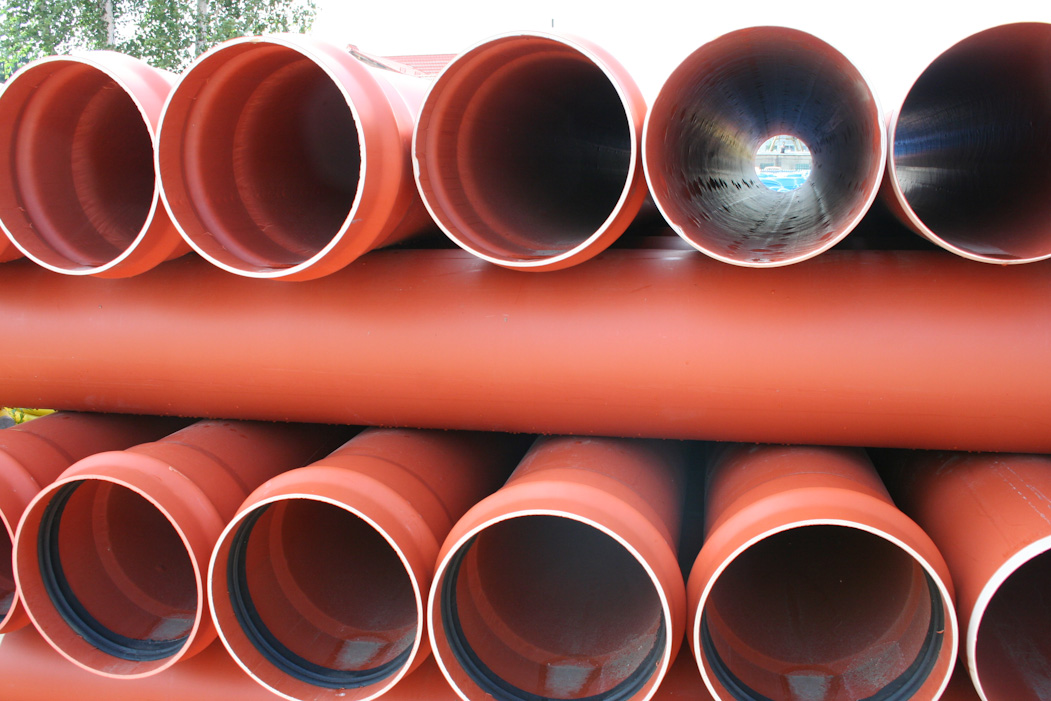
PVC sewer pipe has thinner walls than Schedule 40 DWV PVC. PVC sewer pipe is available in standard length of 3 m (10′) including the bell end. PVC sewer comes in sizes 3 – 6″. PVC is available with solvent ends and with either solid or perforated walls. It is usually white in colour.
Solid wall PVC pipe is used to collect wastewater and storm water from the building drains and convey it to the municipal sewer lateral at the property line.
Perforated pipe is used in septic fields and for foundation perimeter drains or curtain drains to intercept ground water drainage. The perforation holes are [latex]\frac{5}{8} \text{"}[/latex] in diameter. The perforations are located at 4 o’clock and 8 o’clock (on 5″ centres), and the print line is located at 12 o’clock. This allows you to ensure the perforations are oriented correctly.
Clear Plastic PVC
Typical applications for clear PVC include process, sight glass, and dual containment piping as found in chemical processing. Clear PVC is used for high-purity applications, food processing, pharmaceuticals, laboratory use, waste treatment and plating.
Applications and use:
- Used in applications involving fluid transfer where visual monitoring of process lines is required
- Generally corrosion-resistant to most acids, bases, salts, aliphatic solutions, oxidants, and halogens
- Available in iron pipe sizes from [latex]\frac{1}{4} \text{"}[/latex] –12″
- Can be used at temperatures up to and including 140°F
- Pressure rating varies with the schedule and pipe size from 70 – 570 psi
- Belled-end pipe has tapered sockets to create an interference type fit
Markings:
- Manufacturer’s name
- Appropriate ASTM and or CSA standard
- Pipe size
- Schedule 40 or schedule 80
- Date and time of manufacture
- Temperature and pressure limitations
Chlorinated Polyvinyl Chloride
Chlorinated Polyvinyl Chloride (CPVC) is a thermoplastic used in process piping, hot water lines, and other applications where temperatures may exceed those that PVC piping can withstand.
Characteristics:
- Either cream, red, or green in colour
- High resistance to chemicals
- High impact strength
- High tensile strength: more than 13.7 MPa (2000 psi) at 100°C (212°F)
- Withstands high temperatures and pressures
- Canadian standard for CPVC pipe is: B137.6-09
CPVC for Fire Sprinklers
CPVC used for fire sprinkler systems must be a rigid chlorinated polyvinyl chloride compound, Type IV Grade I, with a cell classification of 23447 as defined in ASTM D1784. The compound and the finished product must be orange in colour and be approved by the National Sanitation Foundation (NSF) for use with potable water.
Corrosion-resistant fire sprinkler pipe, IPS sizes [latex]\frac{3}{4}[/latex] –3″, for use in wet automatic fire sprinkler systems.
When installed in accordance with the manufacturer’s installation instructions, this pipe is listed by Underwriters Laboratories (UL) for use in: light hazard occupancies as defined in the Standard for Installation of Sprinkler Systems (NFPA 13); residential occupancies up to and including four storeys in height (NFPA 13R); and residential occupancies as defined in the Standard for Sprinkler Systems in One and Two Family Dwellings and Mobile Homes (NFPA 13D). CPVC fire sprinkler pipe is UL-listed for use in return air plenums (NFPA 90A), system risers per NFPA 13 Light Hazard, 13R and 13D, exposed installations, garages per NFPA 13R, and for use as underground fire service mains (NFPA 24) when installed in accordance with the manufacturer’s installation instructions.
CPVC Dimensions
CPVC fire sprinkler pipe must be manufactured to standard dimension ratio (SDR) 13.5 dimensions in strict accordance to the requirements of ASTM F442 for physical dimensions and tolerances.
Each production run of pipe manufactured in compliance to this standard must also meet the test requirements for materials, workmanship, burst pressure, flattening, and extrusion quality defined in ASTM F442. Furthermore, this pipe must consistently meet or exceed the physical performance test requirements of the appropriate approval/listing agency(s) follow-up procedures established for the product.
Specialty Piping and Tubing
Piping may also be made from substances such as clay, borosilicate (glass), or fibreglass.
Glass Piping (Pyrex Pipe)
Glass piping is usually made of borosilicate glass, which is also used to manufacture tough, durable, chemical glassware. Glass pipe is used in industries such as food processing, chemical and pharmaceutical production, and pulp and paper manufacturing. Short lengths of glass piping may be inserted in opaque piping to serve as sight-flow indicators.
Glass piping qualities:
- Very breakable when dropped or over-tightened
- Extremely resistant to all chemicals (except hydrofluoric acid, phosphoric acid, and some strong alkalis)
- Withstands extremely high and low temperatures
- Very durable
- Has extremely smooth inside surfaces, which reduces pressure loss due to friction and discourages scale build-up
Fibreglass Pipe
Fibreglass-reinforced pipe (FRP) is made from vinyl ester and polyester resins, glass, and reinforcement materials. FRP piping materials are manufactured by winding processes that employ epoxy resins reinforced with continuous glass filaments. The resins used are thermosetting (they undergo chemical reactions as they cure that are irreversible), resulting in superior temperature capabilities, while the filament reinforcement makes the piping components far more capable mechanically than ordinary non-reinforced thermoplastics. The result is enhanced performance and lighter weight.
Fibreglass-reinforced plastic pipe (FRP) characteristics:
- Corrosion resistance
- Extremely hard surface that resists erosion
- Abrasion resistant barrier on the exterior of the pipe as well as the interior
- Durable, resists cracking and crazing of the resin when subjected to heavy design loads
- Heavy exterior coat of resin containing an ultraviolet stabilizer to impart long-term resistance to the effects of sunlight and other weathering elements
- Available in standard sizes 2″ to 36″ diameter
- Pressure ratings: 50, 100 and 150 psi
- Corrosion barrier: 0.100″ (100 mils)
- Resin: corrosion-resistant vinyl ester
Fibreglass pipe uses:
- Motor fuel underground piping—available in diameters of 2–6″.
- Municipal, chemical and industrial applications, including transmission of acids, caustics and solvents, and for cooling tower lines, wastewater treatment process lines, raw water inlet and discharge lines. Pipe diameters range depending on the manufacturer.
- Oil-field production lines, gas gathering lines, tank battery hookups, and salt water disposal/ injection. Standard diameters are available up to 16 inches with pressures up to 3500 psi.
- While sewer and drainage piping continues to be dominated by concrete, there are many areas where FRP is the preferred choice. For example, concrete pipe deteriorates rapidly in sewage due to hydrogen sulfide attack. Hydrogen sulfide erodes the upper surface of the pipe and will eventually cause a cave-in. FRP is unaffected by hydrogen sulfide or purging with caustic or hypochlorite to suppress sulfide odour. As a result, FRP pipe has been used as a liner in large diameter (48 “–60”) concrete pipe.
Vitrified Clay Piping
Vitrified clay piping is no longer widely used but may still be found in building drains. Vitrified clay piping qualities:
- Extremely breakable
- Acid resistant (suitable for use in soil)
Plastic-lined Metal Piping
Plastic-lined piping is lined with thermoset plastics such as polytetrafluoroethylene (PTFE) or polyvinylidene fluoride (PVDF). It’s quite expensive and is used primarily for transporting or containing highly-corrosive or ultra-pure fluids in chemical or pulp and paper plants.
Plastic-lined metal pipe qualities:
- Performs well over wide range of operating temperatures
- Very durable with high tensile strength
Asbestos-Cement Piping
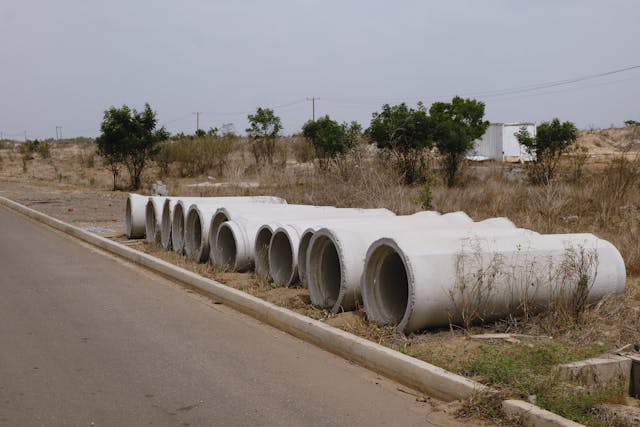
Asbestos-cement pipe is constructed by mixing asbestos fibres with cement. This pipe has been used for water mains, outside sewers, storm sewers, rainwater leaders, drainage and vent systems. Asbestos-cement is no longer available but may be found in existing systems.
 Due to health concerns, before working on this type of piping, check WHMIS and WorkSafeBC regulations and follow provincial regulations for the handling of the product.
Corrugated Stainless Steel Tubing
Corrugated gas tubing is easily distinguished by a flexible yellow polyethylene jacket on the outside. Gas connectors will often have a coating on the outside—not a jacket. Corrugated stainless steel tubing (CSST) will also be identified as such on the jacket itself. The general rule for CSST is that it must be installed in accordance with the manufacturer’s instructions. Before installing this CSST piping, you must first complete the manufacturer’s training program.
Standards: ANSI LC1-2005, CSA 6.26-2006, “Fuel Gas Piping Systems Using Corrugated Stainless Steel Tubing (CSST).”
Characteristics:
- Flexibility over rigid piping
- Does not require intermediate joints and is capable of being installed in one continuous run
- Easily avoids existing obstacles
- Well-suited for locations that are prone to seismic activity because the tubing is able to move as the ground or the structure shifts
- Must be properly bonded/grounded
Typical corrugated stainless steel tubing system (CSST) specifications:
- Made of type 304 alloy; ASTM A240.
- An annealing process tempers the steel, giving it added flexibility and ease of bending
- Suitable for use with elevated pressure systems
- The ANSI LC1 standard rates CSST for use at pressures up to 5 psi
- CSST fittings have standard NPT threads and may be used in combination with all approved fuel gas piping materials with the pipe threads as the interface
- System components such as manifolds, tees and stub-outs may be fabricated from other approved materials to be used with CSST flexible gas piping.
Corrugated stainless steel tubing manufacturers have also developed a lightning-resistant system. The product has a unique layer of metal mesh, designed to dissipate heat and electricity. The mesh is placed between two jackets of semi-conductive polymer. Fittings have been designed to ensure seamless continuity with the mesh with a feature that bites through the first layer of semi- conductive polymer and into the metal mesh. This creates electrical continuity throughout the system, eliminating the need for manufacturer required bonding.
Reinforced Hydraulic Tubing (Hydraulic Hose)

Unlike metal tubing, hose is flexible, so it is used primarily to allow relative motion between components at either end of the hose assembly and to simplify routing and installation. It’s much easier to route a hose assembly over, under, around, or through a series of obstacles than it is to bend and install a rigid tubing assembly. Furthermore, replacing a hydraulic line by fabricating a rigid tube assembly often is more costly and time consuming than making a hose assembly.
A hydraulic hose is built up with rubber and steel layers. A rubber interior is surrounded by multiple layers of woven wire, for reinforcement, and rubber as shown in Figure 15. The exterior is designed for abrasion resistance. Hydraulic hoses generally have steel fittings swaged on the ends.
Reinforced hydraulic hose applications:
- Oil lines
- Hydraulic jacks
- Antifreeze and water fluids
- Natural and propane gas and liquids
Sample manufacturer’s specifications for hydraulic hose:
- For high-pressure hydraulic oil lines
- Meets SAE 100R16 requirements and performance requirements of EN 857 2SC
- M2T hose has smaller exterior dimensions and significantly tighter bend radius
- Tube: black, oil resistant, synthetic rubber (Nitrile—Type C)
- Reinforcement: two braids of high-tensile steel wire
- Tubing cover: black; oil-, abrasion-, and weather-resistant; synthetic rubber (modified nitrile)
- Dual green stripe lay-line
- Temperature range: -40 °F to +212 °F (-40 °C to +100 °C)

 Self-Test D-1.1: Describe Piping and Tubing Materials
Complete Self-Test 1.1 and check your answers.
If you are using a printed copy, please find Self-Test D-1.1 and Answer Key in the Appendix at the end. If you prefer, you can scan the QR code with your digital device to go directly to the interactive Self-Test.

References
BC Industry Training Authority. (2019). Piping trades apprenticeship program: Use Tools and Equipment—Level 1 harmonized [Binder]. Crown Publications, Queen’s Printer for British Columbia. https://www.crownpub.bc.ca/Product/Details/7960000261_S
- Plumber: Competency D-1 Prepare Pipe
- Steamfitter: Competency D-4 Layout and Install Piping and Tubing
- Sprinkler Fitter: Competency D-1 Prepare Pipe and Tubing
British Columbia Ministry of Municipal Affairs. (2018). British Columbia plumbing code (BCPC). https://www.bccodes.ca/
CSA Group. (n.d.). Standards. https://www.csagroup.org/standards/
Government of British Columbia. (2025). BC building code 2024. https://www2.gov.bc.ca/gov/content/industry/construction-industry/building-codes-standards/bc-codes/2024-bc-codes
Government of British Columbia. (2025, June 10). BC plumbing code 2024. https://www2.gov.bc.ca/gov/content/industry/construction-industry/building-codes-standards/bc-codes/2024-bc-codes/plumbing
Lee, R. A. (2006). IPT’s pipe trades handbook and training manual. IPT Publishing and Training Ltd. https://iptbooks.com/pipe-trades/
Media Attributions
All figures are sourced from Industry Training Authority (2019) and/or Camosun College (2019) and are used under the Creative Commons Attribution 4.0 (CC BY 4.0) licence unless otherwise noted. Images copyrighted by the BC Industry Training Authority are licensed under a Creative Commons Attribution-NonCommercial-ShareAlike 4.0 (CC BY-NC-SA 4.0) licence.
- Figure 4 Permendur by Nickel-cobalt alloy on Wikimedia Commons is used under a CC BY-SA 4.0 license.
- Figure 5 Copper pipe (Messschieber misst Rohrinnendurchmesser) by Rhetos from Wikimedia Commons is used under a CC0 1.0 Public Domain license.
- Figure 6 Aluminum Pipes by Zakhar Vozhdaienko from Pexels is used under the Pexels license.
- Figure 7 Cast iron by Moonik from Wikimedia Commons is used under a CC BY-SA 3.0 license.
- Figure 8 Ductile pipes for drinking water by Cjp24 from Wikimedia Commons is used under a CC BY-SA 4.0 license.
- Figure 9 Carbon pipes by Bakhrom Tursunov from Pixabay is used under the Pixabay content license.
- Figure 10 Seamless Steel Pipe by Los Muertos Crew from Pexels is used under the Pexels license.
- Figure 11 Polyethylene Pipe lengths by GordonJ86 from Wikimedia Commons is used under a CC BY-SA 4.0 license.
- Figure 12 Hdpe pipe installation by Tomascastelazo from Wikimedia Commons is used under a CC BY-SA 3.0 license.
- Figure 13 PVC nonpressure pipe by Стрелец Игорь from Wikimedia Commons is used under a CC BY 3.0 license.
- Figure 14 Industrial Concrete Pipes in Rural Landscape by Andy Coffie at Pexels is used under the Pexels License.
- Figure 15 Hydraulic hose connection [23 0051283 Convair Negative Image – Hydraulic hose connection points (53889743769)] by San Diego Air & Space Museum Archives on Wikimedia commons (originally Flickr) was confirmed to be licensed under the terms of the No known copyright restrictions.
Pipe is generally specified by a nominal inside diameter with a constant outside diameter (OD) and a schedule rating that defines its thickness. Pipe is generally manufactured to one of several international and national industrial standards. In general, “pipe” is the more common term in most of the world, whereas “tube” is more widely used in the United States. (Section D-1.1)
Most often specified by the outside diameter (OD) and wall thickness, but may be specified by any two of OD, inside diameter (ID), and wall thickness. Although standards exist for tube, it’s often made to custom sizes and a broad range of diameters and tolerances. (Section D-1.1)
Organizations or officials (such as inspectors) who enforce codes and regulations and approve whether work meets required standards. (Section D-1.1)
This is the approximate inside diameter. (Section D-1.1)
A standard way of naming pipe size using metric units (millimetres) instead of inches. (Section D-1.1)
Another name for nominal pipe size that refers to the approximate inside diameter of a pipe. (Section D-1.1)
The standard developed in North America for tapered threads is ANSI/ASME standard B1.20.1; may be referred to as MPT (male pipe thread) for external threads, and FPT (female pipe thread) for internal threads. (Note that FPT and MPT are not authorized designations according to the ANSI standard.) (Section D-1.1)
Numbers used to show the wall thickness of a pipe, which affects how strong it is and how much pressure it can handle. (Section D-1.1)
A type of cast iron pipe that is specially made to resist strong acids and corrosive liquids, often used in chemical and industrial systems. (Section D-1.1)
A type of steel pipe made from a solid piece of metal with no welded seams, making it strong and able to handle high pressure. (Section D-1.1)
A type of stainless steel that contains chromium and nickel, making it strong and very resistant to rust and corrosion. (Section D-1.1)
Stainless steel with a maximum of 0.08% carbon that provides good corrosion resistance and strength. (Section D-1.1)
Stainless steel with low carbon content that helps prevent corrosion, especially after welding; the letter L after a stainless steel type indicates low carbon (as in 304L). The carbon is kept to 0.03% or under to avoid carbide precipitation. (Section D-1.1)
Stainless steel with higher carbon content that helps maintain strength at high temperatures; contain a minimum of 0.04% and a maximum of 0.10% carbon; primarily used when the material will be used at extreme temperatures. (Section D-1.1)
A type of stainless steel that is strong and can be hardened by heat, often used where strength and wear resistance are important. (Section D-1.1)
A type of stainless steel that resists corrosion and is magnetic, but cannot be hardened by heat. (Section D-1.1)
A plastic capable of softening or fusing when heated and which hardens once cooled. Can be reheated and melted. Polyethylene and polyvinyl chloride (PVC) are examples of a thermoplastic. (Section D-1.1)
Plastics that become permanently hard when heated and cannot be melted or reshaped again. (Section D-1.1)



.jpg)