Self-Test D-3.2 Describe Connection Methods of Fittings
Complete Self-Test D-3.2 and check your answers.
- To lubricate and seal threaded piping, you should use
- Teflon thread
- Pipe dope
- Silicone
- Plumber’s putty
- Two common forms of Teflon thread sealants are liquid and
- Gelatin
- Spray
- Stick
- Tape
- O-ring and shaped gaskets are used to form seals between
- Bell-and-spigot piping
- Flanged piping
- Groove piping
- Threaded piping
- The most common types of sealing gaskets used in domestic plumbing installations are made from
- Wax
- Lead
- Silicone
- Elastomeric substances
- The sealants that may be toxic and should only be used in well-ventilated conditions include
- Plumber’s putty, silicone caulking, wax
- Silicone caulking, pipe dope, solvent cement
- Solvent cement, vegetable fibre gaskets, wax
- Pipe dope, graphite packing, plumber’s putty
- Ready-made gaskets that fit flat flanges and have matching bolt holes for easy installation are
- Donuts
- Ring gaskets
- O-rings
- Self-sealing gaskets
- A self-sealing gasket is found in a
- Victaulic fitting
- Bell-and-spigot joint
- Full face flange
- Mechanical joint coupling
- Thread compounds act to lubricate, seal and protect threaded pipe joints from
- Overtightening
- Damage from rapic temperature changes
- Rust and corrosion
- Staining
- Metal gaskets are usually found in
- Fixture drains
- Industrial applications
- Medical fixtures and fittings
- Hot water piping
- The sealant used to form watertight seals under faucets, drains and strainers
- Plumber’s putty
- Silicone caulking
- Solvent cement
- Teflon
For questions 11 to 15, use the set times and cure schedule for PVC solvent cements shown in Table 1.
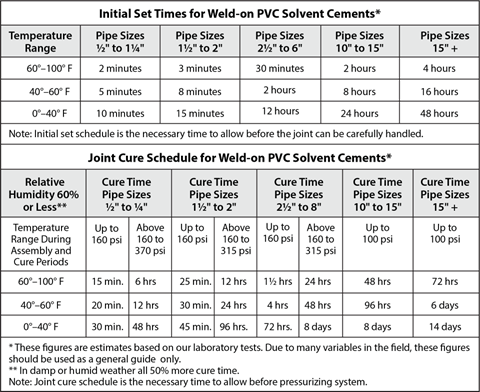
- If you were sealing 1/2 PVC piping inside a house, in the summer, how much time should you allow for the cement to set?
- 2 minutes
- 2 minutes
- 2 minutes
- 2 minutes
- How long would you allow the 1/2 PVC piping to cure completely?
- 15 minutes
- 20 minutes
- 30 minutes
- 6 hours
- If you were sealing 6 PVC piping in an irrigation system on a mild, dry day in the middle of winter, how long would you allow for the cement to set?
- 10 minutes
- 15 minutes
- 30 minutes
- 2 hours
- Assuming that the irrigation system was at pressures above 160 psi, how long would you allow the joints to cure?
- 12 hours
- 24 hours
- 48 hours
- 8 days
- If you had to solvent weld 2 PVC piping at freezing temperatures, how long would you allow the joint to set?
- 3 minutes
- 5 minutes
- 8 minutes
- 13 minutes
Answer Key: Self-Test D-3.2 is on the next page.