D-3.2 Describe Connection Methods of Fittings
Sealants
Most piping joints are designed to be leak-proof. Sealants, such as thread compounds, gaskets made of elastomeric or fibrous substances or some type of packing can be used to prevent leaks. Sealants may be used in combination with gaskets to ensure that liquids or gases do not leak out and that dirt and contaminants are prevented from entering the piping system.
An effective sealant should have some or all of these characteristics:
- Spread evenly over piping surface or threads
- Seal tightly
- Be non-hardening (should act as lubricant)
- Withstand system temperatures and pressures
- Withstand corrosive effects of pipe contents resist rust and corrosion
- Not leach into piping contents
Piping installation codes may prohibit the use of certain types of compounds, especially on potable water systems.
These common types of sealants are:
- Thread compounds
- Gaskets
- Packing
- Plumber’s putty
- Silicone caulking
Thread Compounds
Thread compounds (often referred to as pipe dope) are used to ensure a tight seal between threaded piping and fittings. Thread compounds also act as lubricants as joints are tightened. When a wrench is used to run up the threads, the amount of torque required to tighten the joint and the heat caused by friction will be minimized.
Thread compounds are available to suit each application. They may be in paste, stick, liquid, powder, or spray form. Pastes are usually squeezed from a tube. Sticks are paper-wrapped solids that are scraped off and deposited as the stick is rubbed across threads. Liquid compounds are generally applied with a brush applicator which is often attached to the lid of the compound container. Some types of compounds, such as graphite, are available in powder, liquid, or paste forms.
 Many thread compounds should only be used in well ventilated conditions. Some are flammable or mildly toxic if swallowed or left on skin. Make sure you check the labels on any products you use and obtain Safety Data Sheets from supplier.
Thread compounds have been formulated to be used in a wide range of operating temperatures and pressures. A common line of pipe sealants known as Permatex® has a pipe joint compound that can be applied over grease or oil and is suited to temperature ranges from -54 °C to 204 °C (-65 °F to 400°F). Other popular compounds are available under the line known by the “Unyte” trade name by J. C. Whitlam, a long-running family-owned plumbing chemical manufacturer based in Wadsworth, Ohio. “Tyte-Unyte®” is a type of thread compound safe for potable water systems that has a temperature range from -26 °C to 204 °C (-15 °F to 400 °F) and a pressure range up to 13 790 kPa (2000 psi).
Teflon Thread Compounds
Teflon thread compound is available in tape or liquid form. It can be used when joining iron, stainless steel, aluminum, Monel steel, and plastics. The tape form is widely used because it is simple to use, clean, strong, durable and extremely effective (Figure 1). Teflon® tape can be used in potable water systems.
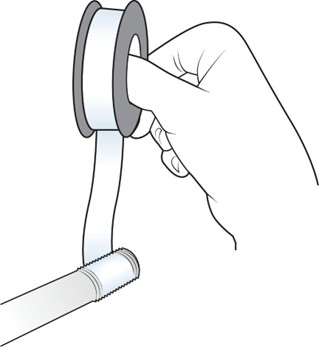
Teflon is widely used because of its superior chemical, thermal, electrical, and mechanical properties. It is non-flammable and does not react with most chemicals. It can be used for a wide range of operating temperatures and pressures. Teflon can withstand pressures up to 13 790 kPa (2000 psi). It is used in systems that carry water, steam, chemicals, hydraulic fluids, natural gas, compressed natural gas (CNG), and liquefied petroleum (LP) gas, freon, and food products.
Graphite Thread Compounds
Graphite is finely-flaked carbon that can be used in powder form or mixed with oils and greases for easier application. It can be used to seal and lubricate all threaded, flanged, and gasketed joints on pipe systems carrying alkalis, brine, acids, steam, air, fuel gas, hot or cold water, and aqueous solvents. It will not harden over time so joints should not seize, and disassembly for maintenance is relatively easy.
 Graphite mixed with oil or grease must never be used on medical gas piping.
Liquid Thread Compound
Liquid thread compounds can be easily brushed on pipe threads (Figure 2).
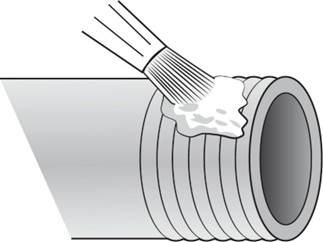
Lead-based compounds are not suitable for portable water service piping. Lead is toxic if ingested. Dispose of in accordance with provincial regulations. Refer to the compound product Safety Data Sheet (SDS) for detailed information.
Applying Thread Compounds
Before applying any thread compound, check that pipe joint surfaces are clean, free of oil, dirt, scratches, burrs or imperfections. The following basic steps should be followed before applying any type of thread compound:
- Clean external and internal threads.
- Inspect threads for damage. The mating threads should be perfect (sharp at the top and bottom of the thread). Run a tap (for internal threads) or a die (for external threads) to repair any damage.
- Apply thread compound only to external threads. Start from the second thread and apply it to the remaining perfect threads (Figure 3). This will prevent the compound from squeezing into the pipe.
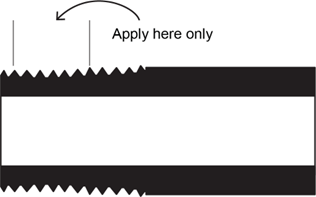
- Engage the threads by hand first and run up the threads as far as possible. Complete the job with a wrench. Be careful not to over-torque the pipe.
Applying Teflon Tape
- Clean and repair the threads as necessary.
- Lay the tape on the externally threaded pipe. Start from the second thread and wrap in the direction of the thread (clockwise for right-hand threads). This will prevent the tape from unravelling when the joint is tightened. Wrap the tape in a spiral fashion, overlapping half the width of the tape as you go up the pipe. This will provide two layers of tape where the threads are engaged.
- Engage the threads by hand first and run up the threads as far as possible. Be careful not to over-torque the pipe when using a wrench for final tightening. Teflon is a very effective lubricant and it is easy to overtighten joints. If joints are overtightened, fittings will stretch and may leak over time.
Gaskets
Gaskets are placed between pipe connections and squeezed together to seal a joint. Sometimes referred to as compression type fittings or connections, gaskets will only form an effective seal if they are smooth and properly aligned. Gaskets will seal joints, prevent leaks and reduce vibration and noise in piping systems.
The shape of a gasket and the type of material it is made from will depend on the piping size, the type of connection (such as flanged, compression or grooved), and the requirements of particular applications. Before selecting a gasket, you must consider the following characteristics:
- Pipe and fitting sizes
- Type of join connection
- Pipe material
- Temperature range
- Pressure range
- Corrosive nature of pipe content
You must also consider whether ready-made gaskets can be purchased or whether they should be fabricated on the job. Full-face gaskets (Figure 4) are ready-made gaskets that fit flat flanges and have matching bolt holes for easy installation. Raised face flanges use ring gaskets without bolt holes.
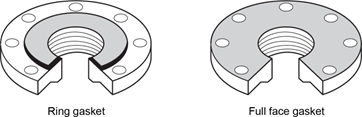
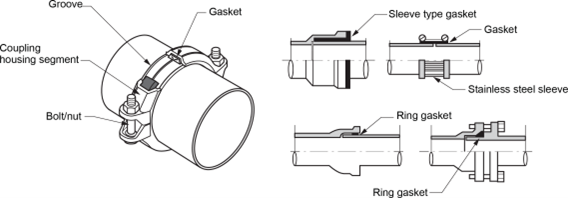
Gaskets made from elastomeric compounds (Figure 5) are found in many types of pipe fittings or joints. Ring gaskets are made of neoprene or other elastomeric compounds that fit inside the hub of piping such as iron soil pipe and form a tight, sealed joint. Sleeve type gaskets are used to seal hub-and-spigot type piping or plain end piping (such as an MJ coupling). Special types of ring gaskets are used inside the housing of Victaulic couplings.
Gasket Materials
Different materials are used to construct different styles of gasket. These include:
- Metal gaskets
- Vegetable fibre gaskets
- Wax gaskets
- Elastomeric gaskets
- Teflon gaskets
Metal Gaskets
Gaskets may be made from tin, aluminum, Monel steel, stainless steel, copper, silver, nickel, brass, iron, low carbon steel and chrome steel. Metal gaskets can be used for high temperatures up to 835 °C (1,600 °F) or for high pressures up to 70,000 kPa (10,000 psi). These gaskets are available in a wide variety of shapes and can be used where rubber or fabric type gaskets are unsuitable.
Vegetable Fibre Gaskets
Natural fibres such as cotton, flax, or cork may be saturated with a glue-glycerin solution and used as gaskets in hydraulic applications, such as pumps. The glue-glycerin solution ensures that they are permanently oil-proof and natural vegetable fibre gaskets can be used for hot oil or steam and hot water applications. They are recommended for temperatures up to 121 °C (250 °F).
Wax Gaskets
Thick, soft wax gaskets are used to seal toilets to floor flanges.
Elastomeric Gaskets
Elastomeric substances such as natural rubber, synthetic rubber and PCV are used to make gaskets for a wide range of applications. They may be found in hot and cold water piping, steam piping and drainage piping. Synthetic rubbers, such as neoprene, silicone, nitrile and Viton A, are recommended for oil and corrosive chemical applications. Newer types of gaskets for sealing floor-mounted or wall-hung toilets may be plastic or special types of foam or neoprene.
Rubber gaskets can be reinforced with high tensile cloth or bronze wire mesh for added strength. Natural rubber gaskets are used for pressures up to 1,050 kPa (150 psi) and over a wide range of temperatures from -54 °C to 150 °C (-65 °F to 330 °F). Synthetic rubbers can be used from -90 °C to 288 °C (-130 °F to 550 °F) and with a wider range of pressures.
Teflon Gaskets
A type of plastic, known as Teflon , is very versatile and durable and can be used with almost any substance. Teflon gaskets can be used in systems that carry acids, alkalis, oil, water or corrosive solvents. These gaskets are suitable for a wide range of temperatures from -268 °C to 288 °C (-450 °F to 550 °F) and high pressures.
Selecting and Applying Gaskets
Before applying gaskets, you must consider a number of factors to ensure that the proper material and shape of gasket is used and that a tight, durable seal will result.
- Determine the fluid contents, operating pressures and temperatures. The gasket may have to withstand very high temperatures and pressures. Materials such as Teflon or metal may be more suitable. Temperatures and pressures may not be the important factor. Some systems carry very corrosive liquids at lower pressures and temperatures. Rubber gaskets may be more suitable than others.
- Consider the type of joint. Is it a flange-type connection or will the gasket be used for pressure type connections between hub-and-spigot piping or fittings? Flange types must be compatible with system pressures. Raised face flanges have smaller surface areas so greater pressure is exerted by the connecting bolts. Full-face gaskets are made to fit flat flanges. If flanges are slightly misaligned, you may choose thicker gaskets to ensure a proper seal.
- Make sure that gaskets are sized so that they will not protrude past the opening of the pipe when the flange or fitting is tightened. An improperly sized gasket will interfere with the flow of liquid or gases through the pipe. When ordering gaskets, specify:
- Normal pipe size (i.e., 6″ pipe)
- Service pressures
- Services temperatures
- Type of fitting
- Pipe contents (intended used)
- With the gasket type selected, check for imperfections in joining surfaces. Clean the end of pipe or flange surfaces. Check for imperfections in mating surfaces such as scratches, warps, or gouges. Make sure all surfaces are clean and dry.
- Check the gasket manufacturer s specifications for the appropriate lubricant or sealant. Some lubricants may damage the gasket material. Plastic piping may require silicone or petroleum jelly. Teflon is widely used. For ring gaskets or Tyton® joints (used to join ductile iron pipe), apply lubricant to the inside of the gasket and to about 75 mm (length of mating surface) of the spigot end of the pipe.
- For hub and spigot type connections, insert the spigot end until it is seated against the gasket and apply pressure until the pipe is firmly seated and sealed. Flange-type connections should be tightened carefully. Align flanges as accurately as possible, insert bolts and tighten.
Packing
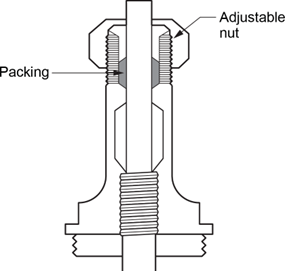
Packing is made of various kinds of pliable materials that will provide a dynamic seal between a moving part and a stationary part. For example, gate valves require packing to prevent leaks from around the centre stem.
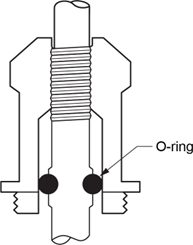
A common type of packing is graphite, held in place by a gland and adjustable nut mechanism (Figure 6). In the gate valve stem shown, the graphite will seal the valve and provide lubrication to the stem as it travels up and down. The rubber O-ring packing shown in Figure 7 is usually lubricated by grease.
Packing is also available in a circular braided ring made of Teflon with a temperature range of -240°C to 315°C (-400°F to 600°F). It can withstand pressures up to 68,950 kPa (10,000 psi).
Other Common Sealants
Plumbers will often use silicone caulking or plumber's putty to seal fixtures and some fittings. Plumber’s putty is a malleable paste that is rolled into narrow tubes or strips and placed under lavatory or shower drain fixtures, under the rim of counter-top basins and wherever watertight seals are required in fixture trim. This type of compound becomes softer as it is kneaded or handled. Plumber’s putty will harden and set but it can always be worked to become pliable again.
Silicone caulking for plumbing applications is an adhesive compound that has mildew-resistant chemicals added. It is available in tubes of various sizes and will remain in a paste-like form as long as it is not exposed to air.
Silicone is applied along joints between bathtubs and acrylic enclosures or tiles, along sink ledges or rims and along all seams of shower enclosures. Silicone sets fairly quickly but must be allowed to cure, usually for 24 to 36 hours, before being exposed to water.
Silicone caulking is toxic and should not be swallowed or left on skin. Use only in well-ventilated conditions. Consult SDS or manufacturers’ directions for safe storage and use.
Solvent Cements
Solvent cements are special types of glue that chemically weld plastic piping together, forming a tight, permanent seal. Some types of cements come in different weights:
- Light
- Medium
- Heavy
- Extra-heavy
Light cements are free flowing while heavier weights become progressively thicker and can be used on larger diameter, thicker walled plastic piping.
Some solvent cements are formulated to seal effectively in wet installation conditions such as irrigation systems, pools and spas. Acrylonitrile-butadiene-styrene (ABS), polyvinyl chloride (PVC), chlorinated polyvinyl chloride (CPVC), polyethylene (PE) and polypropylene (PP) may require different types of solvent cements.
 Solvent cements are flammable and should not be used near heat, sparks or flames. They must be stored in tightly sealed containers at moderate temperatures. Refer to manufacturer’s directions for safe storage and handling.

Solvent cements are toxic. Avoid contact with skin or eyes. Use in well ventilated condition or wear a respirator. Check the Safety Data Sheet (SDS) available for each product.
Solvent cements are spread on the surface of plastic piping with brushes, rollers or daubers. Daubers are similar to a cotton ball on a stick but are made from nylon or cotton fibres. Cements are sold in different sizes of cans or glue-pots and the brush, roller or dauber is usually attached to the inside of the container’s lid.
Solvent cements will generally set within 2 to 5 minutes and cure in 15 to 20 minutes for common plumbing installations. However, setting and curing times will vary with the temperature and the pipe size. Consult manufacturer’s detailed information before applying solvent cement (Tables 1 and 2).
| Temperature Range | Pipe Sizes ½” to 1¼” |
Pipe Sizes 1½” to 2″ |
Pipe Sizes 2½” to 6″ |
Pipe Sizes 10″ to 15″ |
Pipe Sizes 15″+ |
| 60°–100°F 16°-38°C |
2 minutes | 3 minutes | 30 minutes | 2 hours | 4 hours |
| 40°–60°F 4°–16°C |
5 minutes | 8 minutes | 2 hours | 8 hours | 16 hours |
| 0°–40°F -18°–4°C |
10 minutes | 15 minutes | 12 hours | 24 hours | 48 hours |
Note. Initial set schedule is the necessary time to allow before the joint can be carefully handled.
| Relative Humidity 60% or Less** | Cure Time Pipe Sizes ½” to 1¼” |
Cure Time Pipe Sizes 1½” to 2″ |
Cure Time Pipe Sizes 2½” to 8″ |
Cure Time Pipe Sizes 10″ to 15″ |
Cure Time Pipe Sizes 15″+ |
|||||
| Temperature Range During Assembly and Cure Periods | Up to 160 psi | Above 160 to 370 psi | Up to 160 psi | Above 160 to 315 psi | Up to 160 psi | Above 160 to 315 psi | Up to 100 psi | Up to 100 psi | ||
| 60°–100°F 16°-38°C |
15 minutes | 6 hours | 25 minutes | 12 hours | 1½ hours | 24 hours | 48 hours | 72 hours | ||
| 40°–60°F 4°–16°C |
20 minutes | 12 hours | 30 minutes | 24 hours | 4 hours | 48 hours | 96 hours | 6 days | ||
| 0°–40°F -18°–4°C |
30 minutes | 48 hours | 45 minutes | 96 hours | 72 hours | 8 days | 8 days | 14 days | ||
Note. Joint cure schedule is the necessary time to allow before pressurizing system.
*These figures are estimates based on our laboratory tests. Due to many variables in the field, these figures should be used as a general guide, only.
**In damp or humid weather, allow 50% more cure time.
 Self-Test D-3.2: Describe Connection Methods of Fittings
Complete Self-Test 3.2 and check your answers.
If you are using a printed copy, please find Self-Test D-3.2 and Answer Key in the Appendix at the end. If you prefer, you can scan the QR code with your digital device to go directly to the interactive Self-Test.

References
BC Industry Training Authority. (2019). Piping trades apprenticeship program: Use Tools and Equipment—Level 1 harmonized [Binder]. Crown Publications, Queen’s Printer for British Columbia. https://www.crownpub.bc.ca/Product/Details/7960000261_S
- Plumber: Competency D-5 Install Fittings
- Steamfitter: Competency D-2 Install Fittings
- Sprinkler Fitter: Competency D-5 Install Fittings
IPS Corporation. (n.d.). Weld-On cements, primers, and cleaners. https://ipsplumbingproducts.com/brands/weld-on/
J.C. Whitlam Manufacturing Company. (n.d.). https://www.jcwhitlam.com/
Permatex. (n.d.). Permatex: Adhesives, sealants, and repair solutions. https://www.permatex.com/
Media Attributions
All figures are sourced from Industry Training Authority (2019) and/or Camosun College (2019) and are used under the Creative Commons Attribution 4.0 (CC BY 4.0) licence unless otherwise noted. Images copyrighted by the BC Industry Training Authority are licensed under a Creative Commons Attribution-NonCommercial-ShareAlike 4.0 (CC BY-NC-SA 4.0) licence.
A material used to fill gaps and create a watertight or airtight seal between surfaces. (Section D-3.2)
A paste applied to threaded pipe connections to seal gaps, prevent leaks, and make assembly easier. (Section D-3.2)
A type of thread sealant that contains PTFE (Teflon) to help seal threaded connections, reduce friction, and prevent leaks. (Section D-3.2)
A corrosion-resistant metal alloy made mainly of nickel and copper, commonly used in harsh environments such as marine or chemical systems. (Section D-3.2)
A liquid sealant applied to threaded connections to prevent leaks and help seal and protect the joint. (Section D-3.2)
A thread sealant that contains lead, formerly used to seal pipe connections but now restricted or banned in many applications due to health and safety concerns. (Section D-3.2)
(Sometimes referred to as a compression type fitting or connection); A flat sealing material placed between two surfaces to prevent leaks when they are joined together. (Section D-3.2)
A gasket that covers the entire face of a flange, including the bolt holes, to provide a complete seal between two flanged surfaces. (Section D-3.2)
A type of flange with a slightly raised sealing surface that helps concentrate pressure on the gasket to create a better seal. (Section D-3.2)
A circular gasket that fits within the flange faces to create a seal, often used where higher pressure or more precise sealing is required. (Section D-3.2)
A gasket that fits around a pipe inside a joint to help seal the connection and prevent leaks. (Section D-3.2)
Gaskets made of metal that are used in high-pressure or high-temperature systems to create a strong, durable seal. (Section D-3.2)
A mixture used as a lubricant to help gaskets or pipe joints slide into place and form a proper seal during assembly. (Section D-3.2)
Gaskets made from plant-based fibres that are compressed to form a seal, commonly used in low-pressure applications. (Section D-3.2)
Soft wax rings used to seal toilet connections to prevent leaks and sewer gases from escaping. (Section D-3.2)
A material that is flexible and rubber-like, able to stretch and return to its original shape. (Section D-3.1)
Gaskets made from PTFE (Teflon) that resist heat and chemicals and provide a low-friction sealing surface. (Section D-3.2)
A type of push-on pipe joint that uses a rubber gasket inside a bell to create a watertight seal when the spigot end is inserted. (Section D-3.2)
A sealing material made of flexible (pliable) materials that provides a dynamic seal between a moving part and a stationary part, such as around a valve stem to prevent leaks. Common types include graphite packing. (Section D-3.2)
A soft, moldable sealing compound used to create watertight seals around fixtures such as sinks and drains. (Section D-3.2)
A flexible sealant and adhesive compound used to fill gaps and create a watertight seal around fixtures, joints, and surfaces, often containing mildew-resistant chemicals. (Section D-3.2)
A chemical adhesive used to join plastic pipes by softening and fusing the surfaces together to form a permanent bond. (Section D-3.2)
A small applicator tool with a brush or sponge tip used to apply primer or solvent cement to pipes and fittings. (Section D-3.2)